Quick answer: Most ships open their terminal window between 11 a.m. and 2 p.m. on embarkation day. Almost everything that goes wrong for first-timers happens in the gap between that number and the boarding time printed on the ticket. Check in online 2–4 days ahead. Expect the buffet to be the most crowded place on the ship for the first few hours. Don’t panic when your cabin or your suitcase isn’t there yet — both are normal, both are temporary.
I’ve sailed nineteen cruises across five lines, and the first one taught me more than the other eighteen combined. Somewhere between 11 a.m. and 2 p.m. is when most terminals actually start letting passengers through, not the time printed on the ticket.
That gap between paperwork-time and ship-time is where almost every first-cruise mistake happens.
Looking at how new cruisers describe their first day, one pattern repeats. The order of events worries people more than the ship itself does.
- Delayed luggage — comes up constantly
- Port arrival timing — comes up often
- Missing the ship — a regular fear
- The muster drill — mentioned too
- “My cabin wasn’t ready” — barely registers once people are actually aboard
Two moves below go faster with a working phone connection and a ride that’s already booked. That’s why data for the whole trip and a pre-arranged transfer show up early in this list, not as an afterthought.
Boarding Day, Step by Step
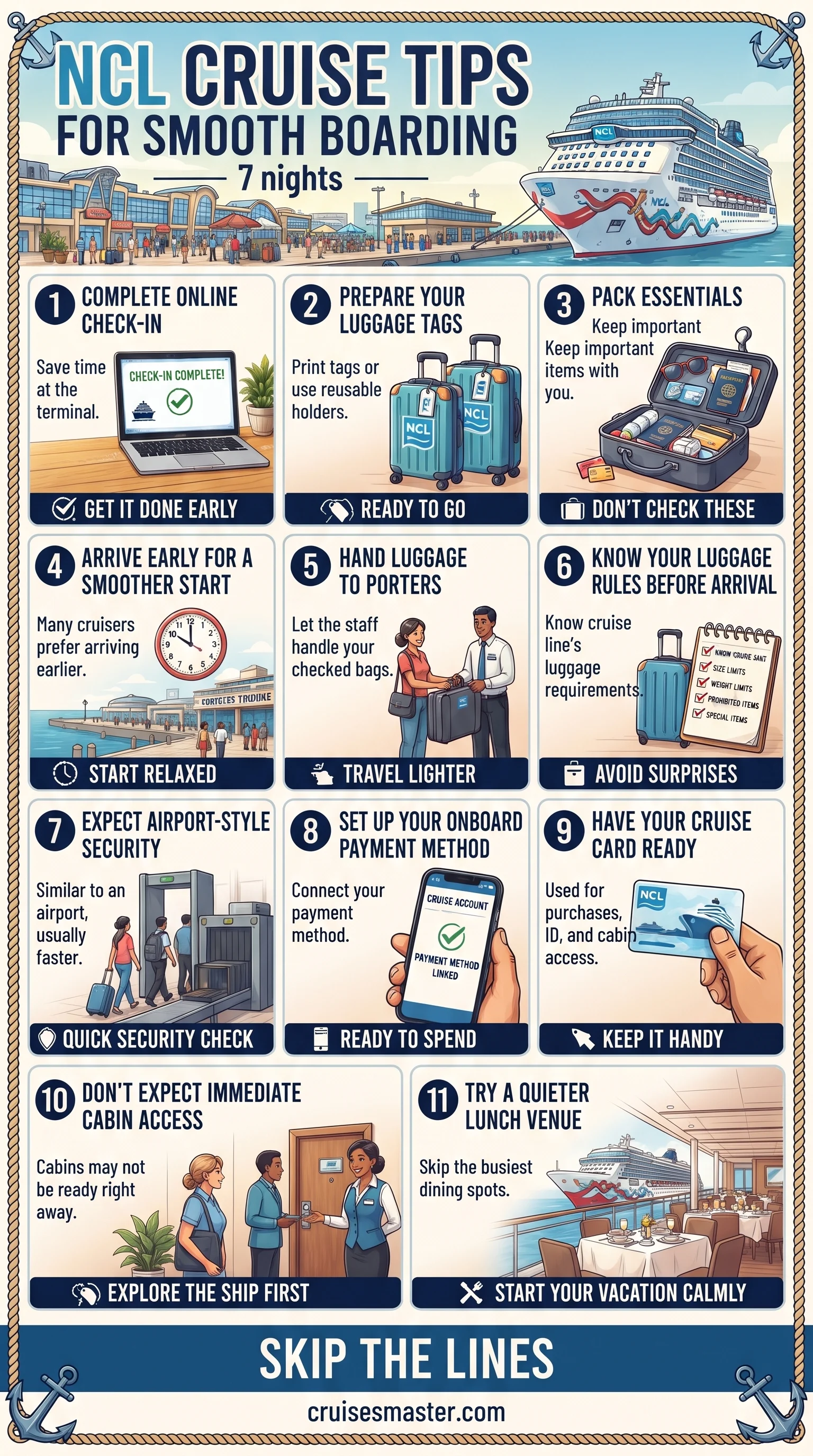
Five moves, in this order, cover embarkation day end to end. Read this sequence once before you leave for the terminal. Everything below expands one step in more depth.
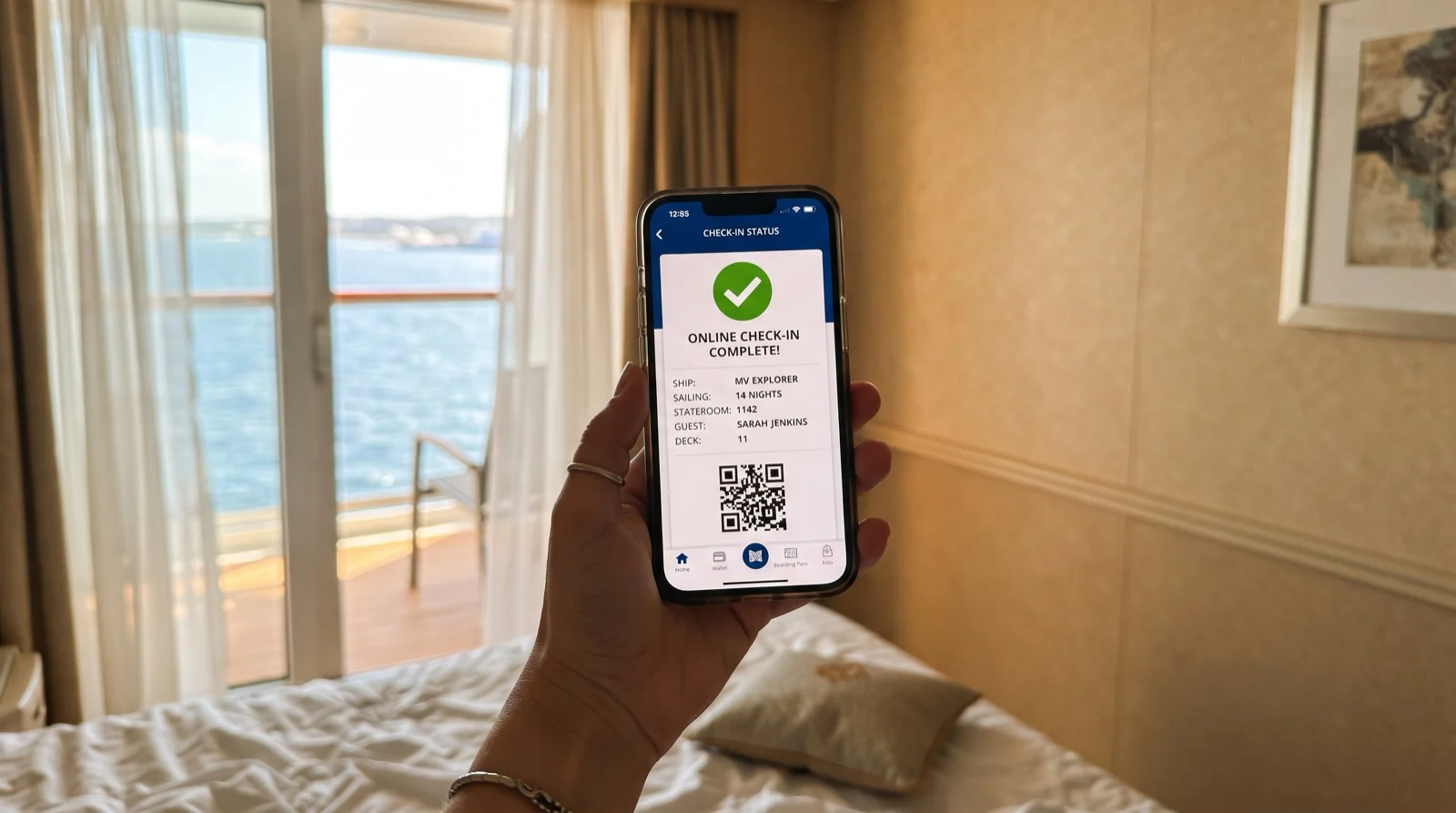
The line’s app needs your check-in finished 2–4 days out, not at the terminal. Do this first. Everything downstream moves faster. It’s also the right moment to set up data for the whole trip: an eSIM covering your full itinerary activates before you fly, not after you land.
Nothing on the ship gets more crowded than the buffet on embarkation day. Everyone boards hungry and heads there first. Go early or go late, not with the crowd.
It takes 10–15 minutes. The ship legally cannot leave the dock until it’s finished. Most of it now happens through the app, before you even reach your station.
Specialty dining and shore excursions have limited seats. Reserve in the first hour aboard, before the cabins open and the app queue backs up.
Your suitcase won’t reach the cabin right away. When it does, unpack straight into the closet. A cabin with clothes still in a suitcase stays cramped for the whole trip. Before you unpack, check my cruise essentials list — half of what you brought, the cabin already has.
Every section below walks through one piece of that order. We’ll start with the single biggest source of first-cruise stress: the gap between the time on your ticket and the time the ship actually needs you back. For more guides like this one, see the cruisesmaster.com homepage.

Why Arrival Time Isn’t Boarding Time
The boarding time on your documents is a scheduling slot, not a deadline. Confusing the two causes most pre-cruise anxiety.
Ports generally open terminal doors somewhere between 11 a.m. and 2 p.m. on embarkation day. That window describes when the terminal starts processing passengers, not when your specific ticket time falls inside it.
Here’s what surprises first-timers: showing up later in that window often means boarding faster. Terminals process passengers in batches through the morning. By early afternoon, the biggest crowds have cleared.
Check-in and boarding together typically take 10–15 minutes once you’re inside. It’s faster still if online check-in is already done with a working connection. The slow part is never the process itself. It’s the traffic getting to the terminal — that’s what I actually plan around now.
| Detail | What to expect |
|---|---|
| Terminal opens | 11 a.m. – 2 p.m. on embarkation day |
| Check-in + boarding once inside | 10–15 minutes |
| Biggest risk on the day | The transfer to the terminal, not the terminal itself |
That’s the part worth over-planning. If you’re flying in, arrive at the port city the night before. It removes the biggest source of first-cruise stress: missing the ship before the trip even starts.
A flight delay the morning of departure turns a manageable inconvenience into a missed vacation. A flight delay the day before is just an early dinner instead of a late one. I always sail in a day ahead now — I learned that one the hard way.
The same logic applies to the ride from the airport or your hotel. This is the one transfer with zero flexibility on the other end.
A delayed cab, or a driver who doesn’t know the port layout, eats directly into your only buffer.
The Muster Drill, Explained
The muster drill is the mandatory safety briefing every passenger completes before the ship can leave the dock. No exceptions, no opting out.
It takes 10–15 minutes, and it has changed shape more than most first-timers expect.
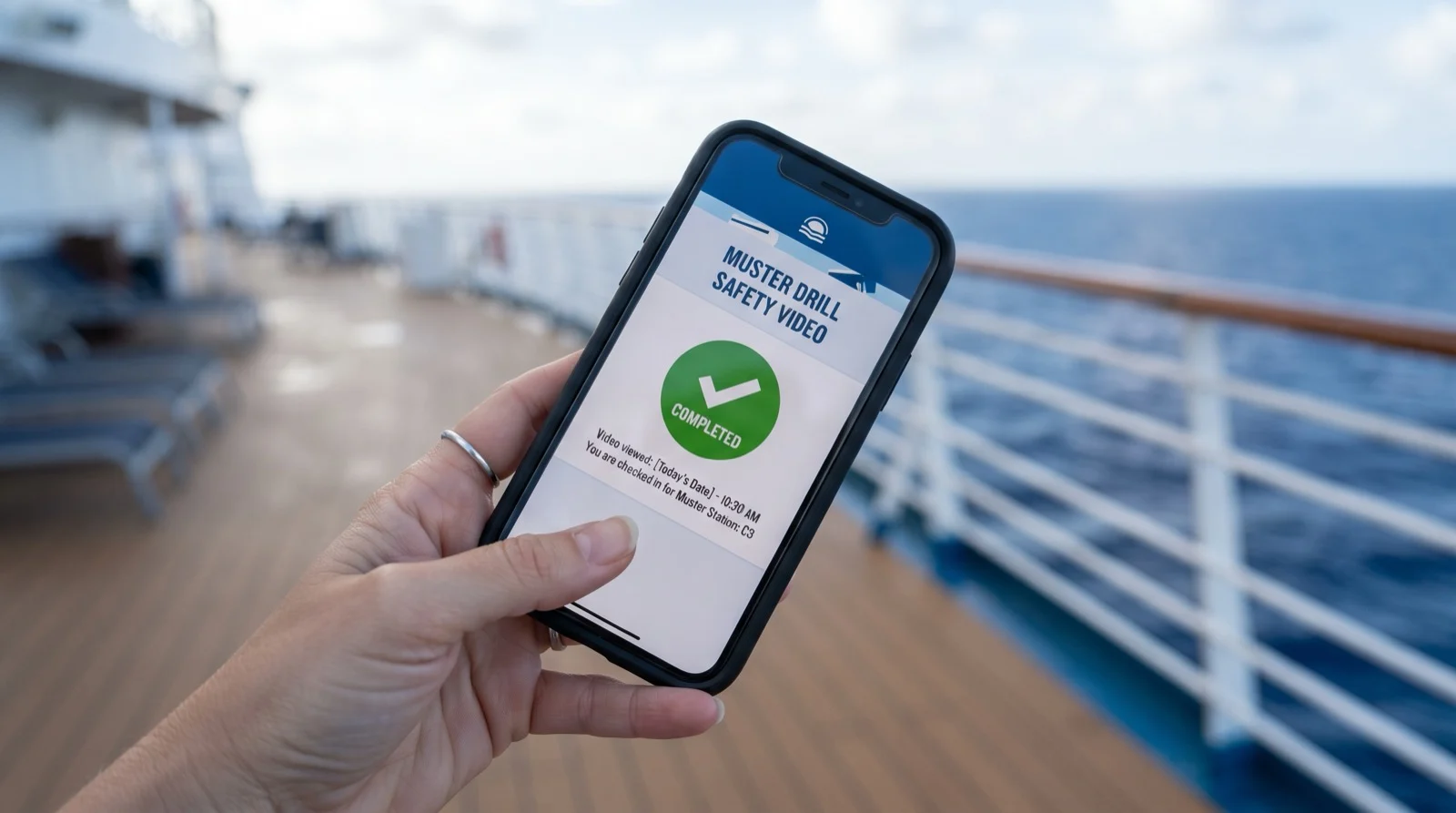
Older cruise stories describe standing in a crowded stairwell for half an hour in a life jacket. I remember that drill from my first sailing. That version is mostly gone now. Most lines run the safety content through the app before you board:
- A short video
- A few taps confirming you’ve watched it
- A brief in-person visit to your assigned muster station
The drill still has to happen before departure. But the app absorbs most of what used to be dead time standing in a hallway.
Do the app portion early — ideally during check-in, while you’ve still got a working connection rather than patchy port wifi. That’s also why it’s worth having data set up for the whole trip before you get near the ship.
What Goes in the Carry-On
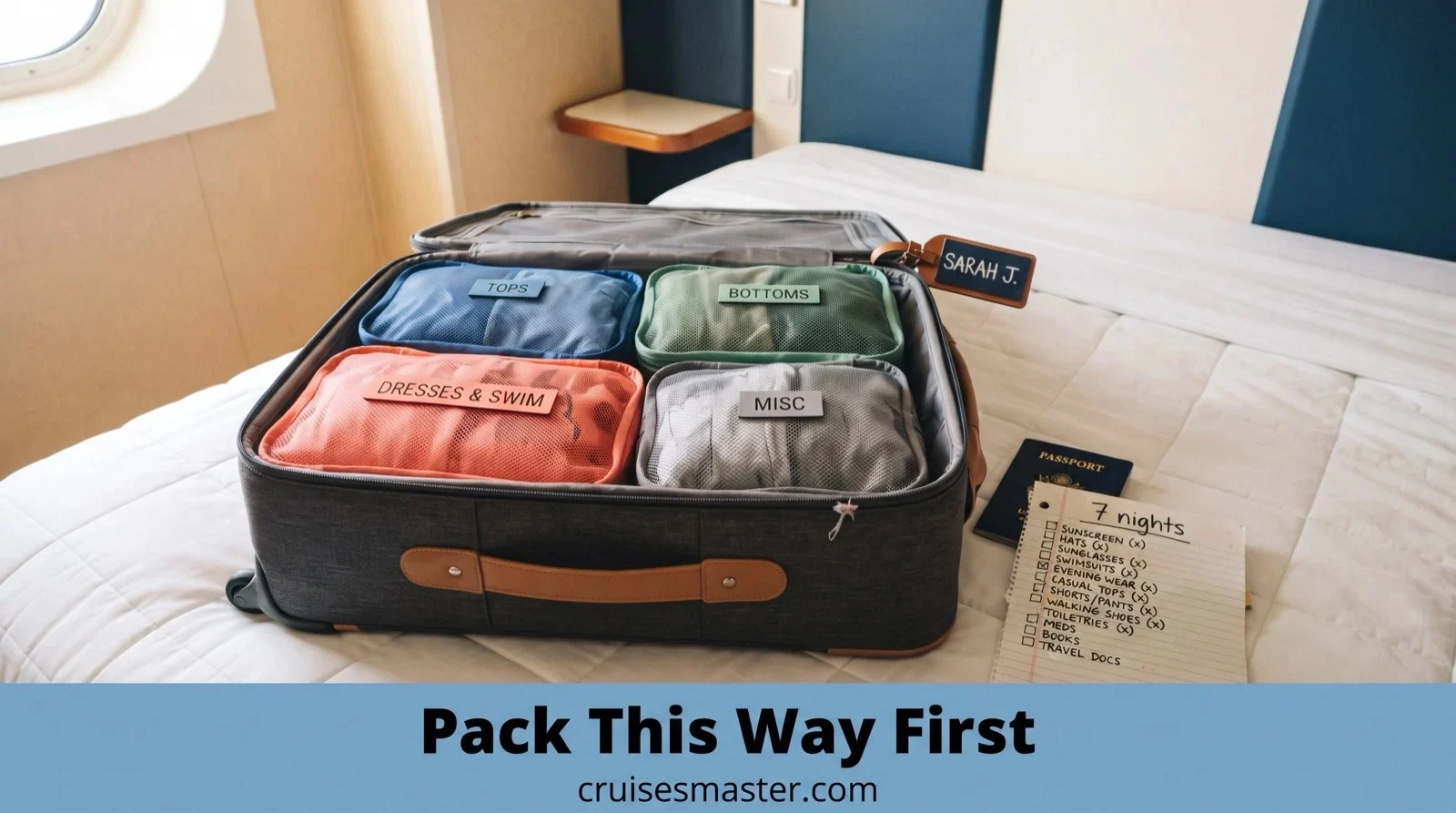
Checked luggage disappears for hours once you hand it over. The carry-on bag has to cover everything you’ll need before it reappears. Four categories belong in it, full stop:
- Medication
- Travel documents
- Chargers
- A swimsuit
Here’s why each one earns its spot:
- Medication — you don’t want to need it while your suitcase is still somewhere in the baggage system
- Documents — passport, boarding pass, any printed confirmations, stay on your person through the terminal
- Chargers — cabins often have limited outlets, and you’ll want your phone alive for the muster drill
- A swimsuit — the pool deck is usually the one pleasant spot during that crowded first afternoon
Still deciding what else to wear? What to wear on a cruise covers that separately, including how few pieces cover a full week.
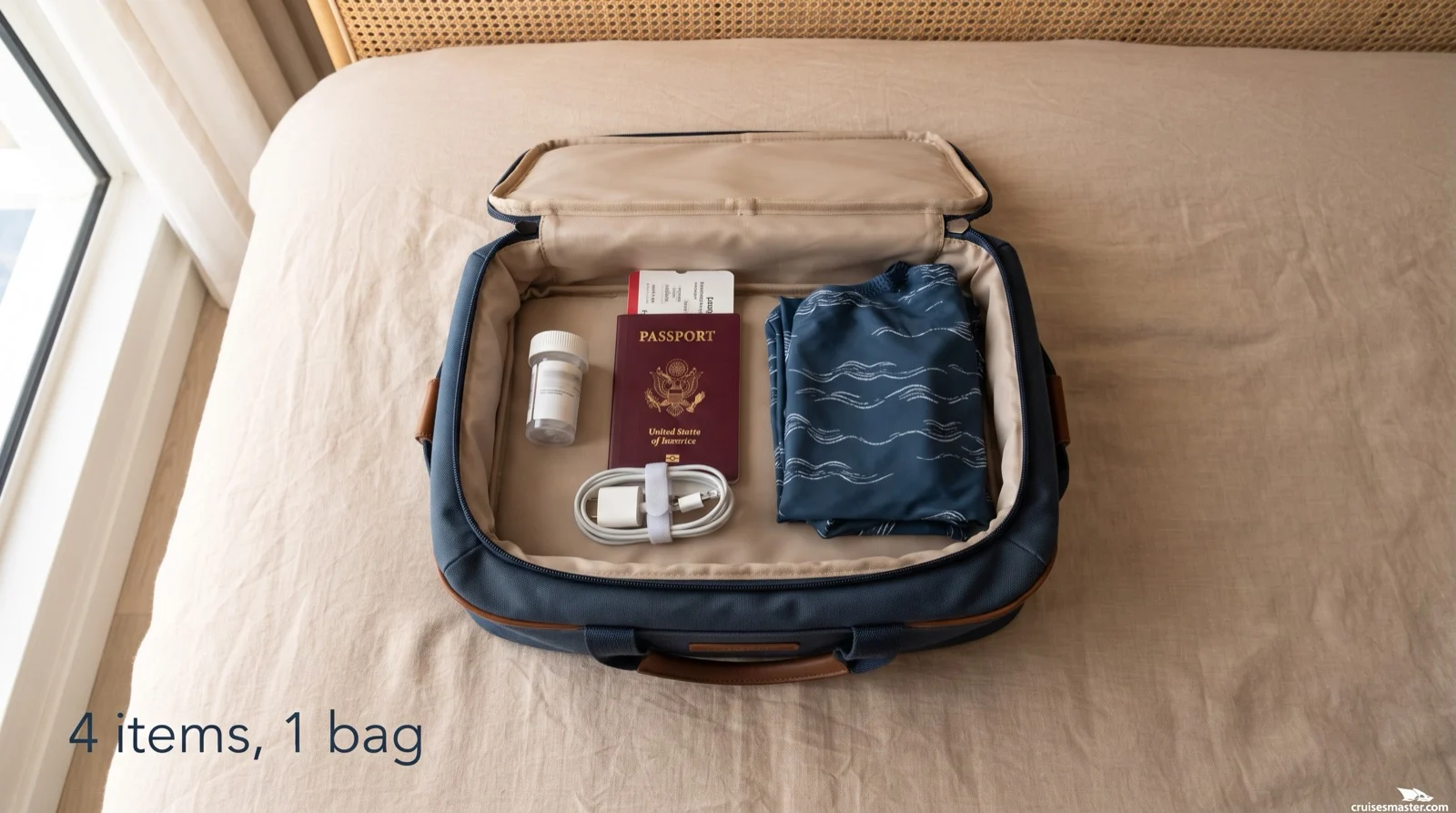
The four items worth having on your person before the ship pulls away: medication, documents, a charger, a swimsuit.
Alcohol rules vary by line, not by one universal policy. On some lines, each cabin can bring aboard up to two bottles of unopened wine or Champagne, or six beers, without an extra charge, as part of carry-on rather than checked bags.
That’s specific to your line, so confirm it before you pack. For the rest of the suitcase, including what actually gets pulled at the terminal, see the full cruise packing list.
One more thing worth handling before the terminal: data. Port wifi is unreliable, and ship wifi is usually a paid add-on you haven’t decided about yet.
But you’ll want a connection the moment you land — for the transfer booking, for the app check-in, for texting family that you’ve arrived. Yesim sets this up for the full itinerary in advance, so it’s active before you land rather than something to sort out at the port.
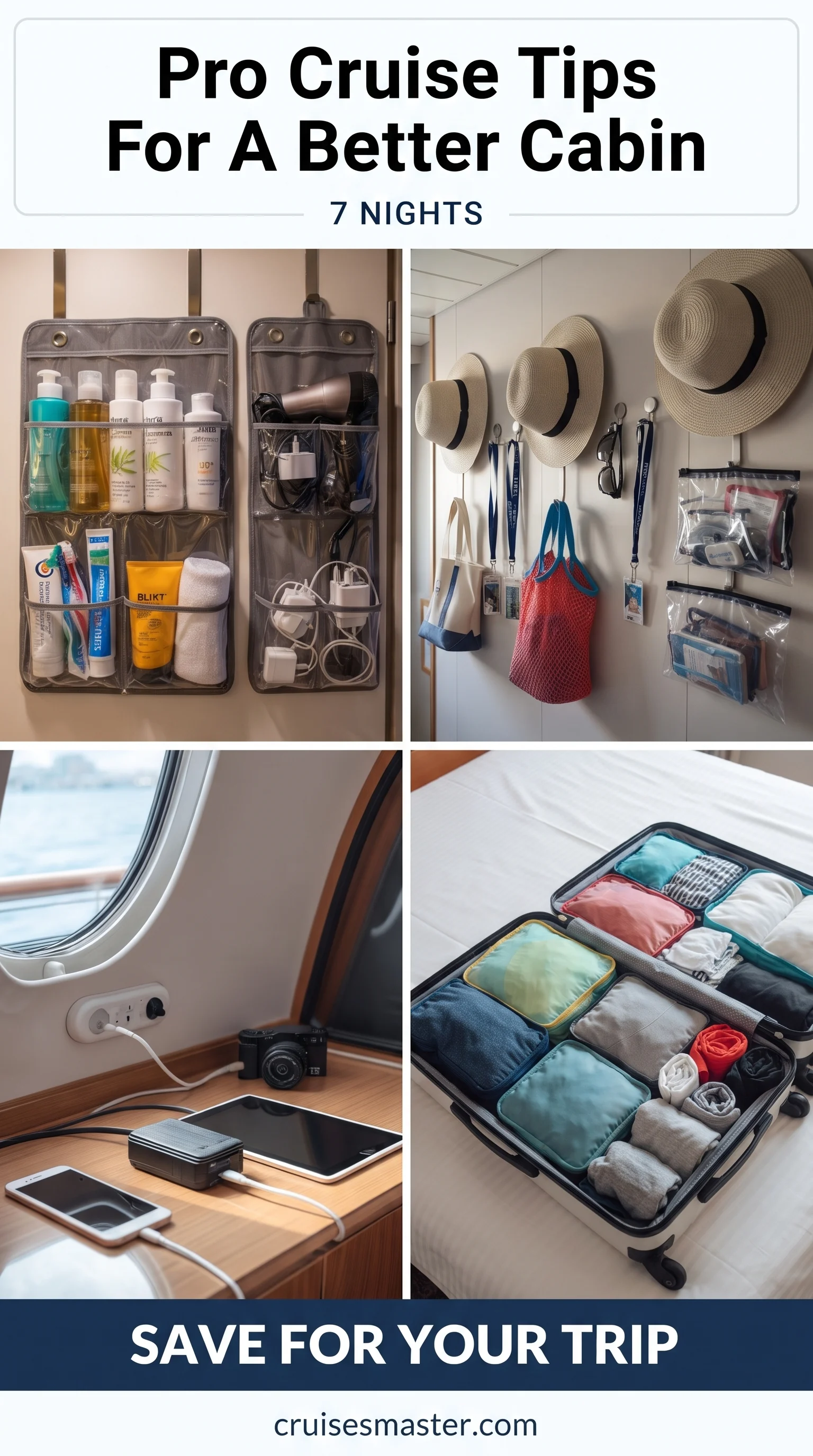


Why Your Luggage Doesn’t Meet You at the Cabin
Checked bags get handed over at the terminal, not carried aboard with you. They travel through a separate system from the one that processes passengers. That’s normal, but the bag can take several hours to reach your cabin door — sometimes arriving well after dinner.
This single detail causes more first-cruise anxiety than almost anything else about the day. Delayed luggage is the single most-mentioned worry tied to embarkation day, far more than the muster drill or the cabin itself.
The gap between handing a bag over and seeing it again just feels wrong the first time, even though it’s completely standard.
The practical response is the carry-on strategy above. Pack anything you’d need in the first few hours into the bag that stays with you, and let the checked suitcase take its time.
When it arrives, a crew member usually leaves it outside your door, or a notification comes through the app — one more reason to have a working data connection from the moment you board.
Unpack it into the closet right away rather than living out of it. A half-unpacked suitcase on the floor makes a small cabin feel smaller for the rest of the cruise. I learned that one fast.
Wondering if it’s worth checking a full bag at all? What actually gets taken versus what comes home unused is worth a look first.
| Checked bag | Carry-on bag |
|---|---|
| Arrives hours later, sometimes after dinner | Stays with you the whole time |
| Delivered by a crew member or app notification | Medication, documents, charger, swimsuit |
What to Do in the First Empty Hour Aboard
Boarding puts you in a strange window: you’re on the ship, but your cabin almost certainly isn’t ready, and won’t be until roughly 1:30 to 2 p.m.
Your instinct might be to wait it out near your cabin door. That’s the wrong move.
The buffet is packed. Genuinely, nothing on board is more jammed than a cruise ship buffet on embarkation day, because everyone who just boarded is hungry and heads there first. Fighting that crowd for a table isn’t a good use of the empty hour.
What is a good use of it: this is the exact window when shore excursions, specialty dining, and spa slots are still wide open. Book now, before everyone else finishes eating and wants the same slots.
I’ve noticed “the cabin wasn’t ready” barely registers as a complaint once people are past it. It bothers people less than they expect.
So: eat early or eat late, not now. Spend the empty hour locking in reservations through the app instead of hovering by a locked door — one more reason a data connection that’s already working beats fighting for the ship’s wifi login at the exact moment everyone else wants the same slots.
By the time your room opens, you’ll have the day planned instead of scrambling.
| Skip | Do instead |
|---|---|
| Waiting by the locked cabin door | Book excursions, dining, spa slots — still wide open |
| Fighting the buffet crowd right away | Eat early or eat late |
Cabin Location and Motion Sickness
Two separate issues get decided by the same choice: which cabin you booked. If you’re prone to motion sickness, book low and midship. Those cabins move the least. I always check this before booking, not after I’m already queasy on day two — any remedy, bands, patches, tablets, works better started before symptoms begin.
Separately from motion, two locations are worth avoiding regardless of how well you handle the sea:
- Rooms near elevator banks — foot traffic and mechanical noise at all hours
- Rooms above nightclubs — bass through the floor until closing
On larger ships, the ones carrying 5000 or more passengers, elevators get genuinely busy at peak times. Waits of 5 to 10 minutes are normal during the dinner and show rush. A cabin near a bank of them means listening to that traffic every day.
Check deck plans and cabin-location details on your phone before you’re standing at the terminal with no signal — the same reason data active before you land is worth setting up ahead of the booking call.
| Avoid | Why |
|---|---|
| Cabins near elevator banks | Foot traffic and mechanical noise at all hours |
| Cabins above nightclubs | Bass through the floor until closing |
| Upper, off-center decks (if prone to motion sickness) | Move the most; low, midship moves the least |


What the Fare Doesn’t Include
The ticket price covers the cabin and main dining. Three things ride on top of it that don’t show up unless you go looking: the daily service charge, drink packages, and wifi — the last one solved before you fly with an eSIM data plan rather than paying the ship’s per-day rate.
Most quoted fares are also priced on double occupancy. A solo cruiser, or a third and fourth person sharing the room, changes what lands on the final bill.
| Extra cost | How it shows up |
|---|---|
| Daily service charge | Automatic, per person, added to the onboard account (unless folded into fare) |
| Bar gratuity | 18–20% automatically on every drink |
| Wifi | Ship’s per-day package unless solved with your own eSIM beforehand |
Gratuities catch the most first-timers off guard. Lines handle them differently by design. Some fold gratuities into the fare you already paid. Others add a daily service charge automatically. Others leave tipping entirely optional.
None of these is wrong. But assuming your line works like the one a friend sailed on is how people get surprised by a line item on the final bill. I check mine every single time.
On top of the daily charge, most ships automatically add a gratuity to bar bills — often 18% to 20%, every time you order, whether or not you’re on a drink package. A five-drink evening adds up faster than the cocktail menu suggests.
None of this is hidden exactly. It’s disclosed somewhere in the booking paperwork. But almost nobody reads that far in, which is why it feels like a surprise on day one. Wifi is worth solving before you board: an eSIM covering the ports on your itinerary works the moment you’re in range of land.
Cruise Tipping, With Numbers
Cruise gratuities usually run as a daily per-person service charge added automatically to the onboard account, separate from an automatic 18–20% bar gratuity on every drink. Some lines fold the daily charge into the fare instead, and a few leave it fully optional at guest services.
Do cruise tips go to the staff?
Yes. Whichever form your line uses, the daily service charge or the automatic bar gratuity is how the line distributes tips to the crew — not a fee the line pockets. It funds cabin stewards, dining staff, and the crew you rarely see, like laundry and galley teams.
The exact split between departments isn’t usually published. I check it on my line’s own page with a connection that’s already working once I’m at the terminal.
| How your line might handle it | What lands on your bill |
|---|---|
| Folded into the fare | Nothing extra |
| Automatic daily service charge | Runs on the onboard account all week |
| Fully optional | Nothing unless you arrange it yourself, usually cash |
How much are cruise tips per day, and how does the charge actually work?
It depends entirely on the line. Some fold gratuities into the fare, so nothing extra hits your account. Others add a daily service charge automatically, per person, that runs across the week.
Others leave it fully optional, added or removed at guest services. None of the three is “normal” industry-wide. Confirm which one your line uses before you sail, and you avoid the final-bill surprise almost every first-timer describes.
Which cruise lines include tips in the price?
This varies by line, and sometimes by fare class on the same line. Some fares are marketed as “gratuities included,” others aren’t, and a promotional fare can change which bucket you’re in even on a line you’ve sailed before. Check the specific fare’s inclusions when you book, and again at online check-in.
What happens if you don’t pay the daily gratuity?
On lines that add it automatically, most guests leave it in place, since it’s how the crew who worked your cabin and meals get paid. Guest services can adjust or remove it on request, but doing so removes pay from the specific crew who served you.
On lines where tipping is fully optional, nothing is charged unless you arrange it yourself, usually in cash. That’s the same cash you’ll want on hand for a port-side transfer if you haven’t pre-arranged a pickup.
Do bartenders and specialty-dining staff get tipped separately?
Usually, yes. The bar gratuity, that automatic 18% to 20% on every drink, is separate from the daily service charge and goes toward bar and beverage staff specifically. Specialty restaurants often carry their own gratuity line too. Both stack on top of the daily charge rather than replacing it.
Can you tip cruise staff in cash?
On most lines, yes, in addition to or instead of the automatic charge, though the automatic charge is still how most crew actually get paid. Cash tips are a personal extra for someone who stood out, not a substitute for adjusting the daily charge off.
Check your line’s current policy before assuming. It’s worth confirming on your phone at the terminal, where a working data connection makes it a two-minute check instead of a shrug.
Check Your Line’s Own Rules Before You Pack
Cruise lines don’t run on one shared rulebook. Dress code, what you’re allowed to bring aboard, how the app handles check-in — all of it varies by line.
Packing for “a cruise” in the abstract, instead of for your specific line, is how people end up with the wrong stuff in their suitcase.
Carry-on alcohol allowances are worth checking before you pack. Some lines permit a set amount of wine or beer with no extra fee. Others don’t allow it at all. The specifics — bottle count, beer versus wine, per cabin or per adult — differ by line.
Check your specific line’s current policy directly, while you’ve still got a reliable connection to read the FAQ page. Once the line-specific rules are confirmed, what people actually decide to bring versus leave behind matters almost as much as what makes the list.
Formal Night: What the Dress Code Actually Requires
Formal night has a reputation that doesn’t match reality. Black tie, strict enforcement — most ships simply don’t live up to that image anymore. The actual policy on most lines is relaxed and optional, closer to “wear something a little nicer” than “you will be turned away from dinner.”
Packing a full tuxedo, on a line that treats it casually now, means carrying dead weight in your suitcase. I stopped doing that after my third cruise. See what actually works for formal night for outfit specifics.
The safest read: bring one outfit a notch above what you’d wear the rest of the week — a collared shirt or a dress, not shorts and a t-shirt. Treat the main dining room’s formal night as optional. Specialty restaurants and the buffet almost never enforce it, so skipping it and eating elsewhere is a normal choice, not a faux pas.
It’s also why a handful of repeatable outfits beats packing something new for every night. If your line’s app describes a stricter policy, confirm it directly — check it on the app before you pack, with data already working instead of waiting for port wifi to load a PDF.
| What people expect | What most lines actually require |
|---|---|
| Black tie, strict enforcement | “A notch nicer” than the rest of the week — collared shirt or a dress |
| A full tuxedo or gown packed just in case | One repeatable outfit, not a new one per formal night |
| Mandatory for every passenger, every venue | Optional in the main dining room, essentially unenforced elsewhere |


Ship Excursion or Independent Tour in Port
The choice between a ship-booked excursion and an independent tour comes down to one factor that matters more than price: what happens if you’re running late getting back.
At a tender port, the ship anchors offshore and small boats ferry passengers to land. That changes the math on lateness. Missing the last tender back means missing the ship, not just a long walk down a gangway.
Build extra buffer into any independent plan at a tender port specifically.
A ship-booked excursion is the ship’s responsibility to get you back from. If the tour runs long, the ship generally waits, because it sold you that excursion and knows where you are. An independent tour has no such safety net.
If traffic eats into your return time, nobody is holding the gangway for you. That’s exactly why a pre-arranged, tracked ride beats hailing something curbside once you’re already watching the clock. Port days also mean a lot of walking, which is where the shoe choice matters more than anything else you packed.
Either way, the same rule applies: get back at least 30 minutes before the published departure time, not the moment it’s printed. That buffer covers exactly the situation where a tuk-tuk gets stuck in traffic or a tender line runs long.
Treat the printed “all aboard” time as the actual deadline, and the 30 minutes before it as your real return target.
| Excursion type | If you run late |
|---|---|
| Ship-booked excursion | Ship generally waits — it knows where you are |
| Independent tour | No safety net — you cover the gap yourself |
| Either way | Be back 30 minutes before the printed “all aboard” time |
One more thing worth building in deliberately: leave at least one or two ports completely unplanned. Not every stop needs an excursion booked.
A port with no agenda gives you room to wander, or to stay aboard and enjoy a ship that’s suddenly much quieter, with most passengers off exploring.
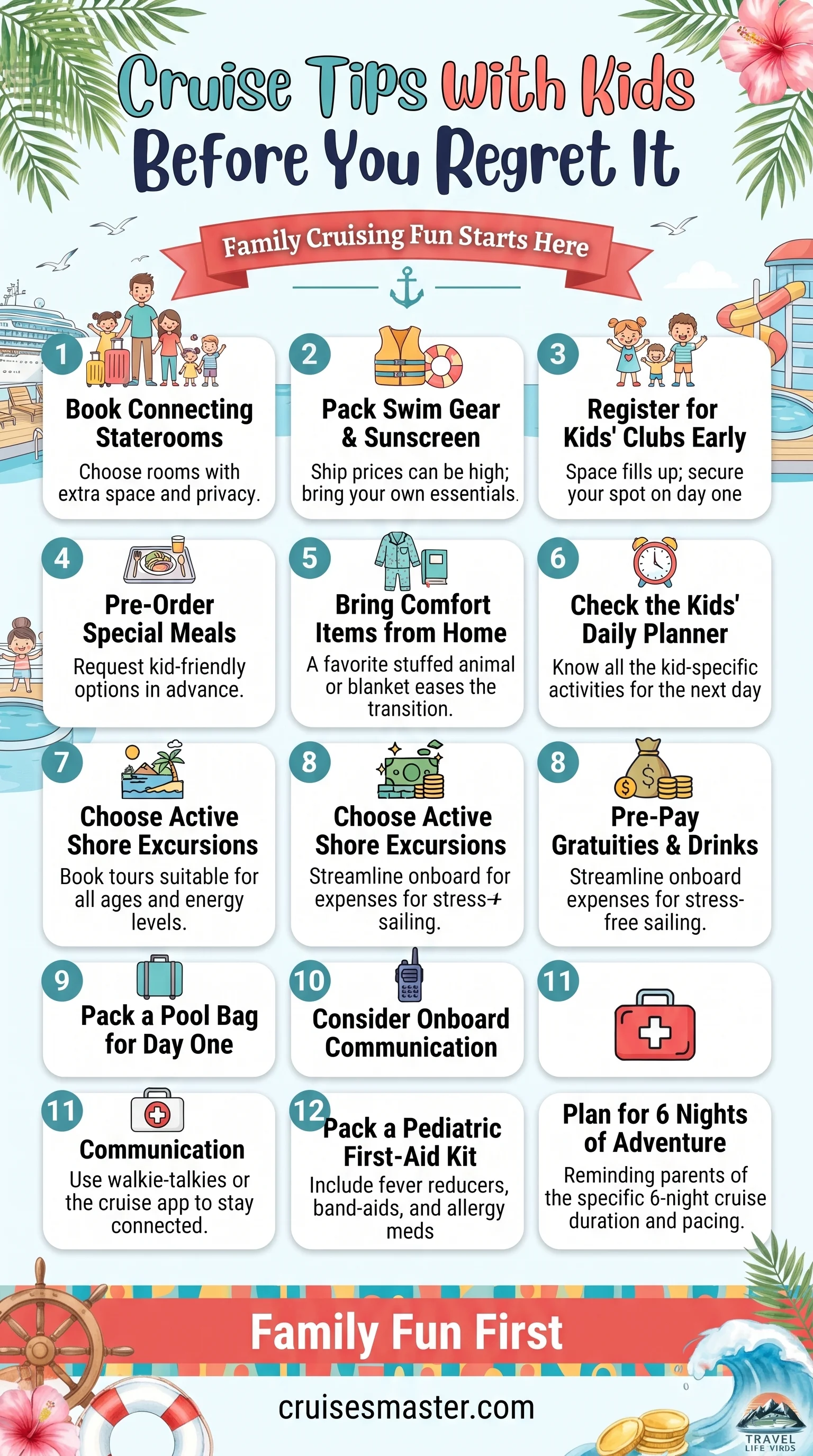
Cruising With Kids: The First Afternoon
The first afternoon with kids goes better when the plan accounts for waiting, not entertainment. Nothing about embarkation day moves at kid-speed.
The buffet is at its most crowded exactly when everyone’s hungriest, and the cabin won’t be ready until roughly 1:30 to 2 p.m., no matter how many times someone asks.
The carry-on bag is where this gets solved in advance. Pack a swimsuit and a full change of clothes counted by night for each kid into the carry-on, not the checked suitcase, which may not reach the cabin for hours.
The pool deck is usually open and far less crowded than the buffet. A swimsuit ready to go turns the empty hour into pool time instead of a line for food nobody wants.
Keep the muster drill on the schedule too. It’s mandatory regardless of passenger age. Do the app portion before you leave for the terminal — one less thing competing for attention once kids are tired and hungry.
The same terminal transfer that matters for any first-timer matters more with kids in tow. A driver who’s already waiting beats hunting for a taxi with a stroller and bags.
Solo, Interior Cabin, or Cruising as a Group: What Actually Changes
Most cruise advice is written for a couple in an ocean-view cabin, so the exceptions get left out.
Three of them matter enough to plan around before you sail.
Solo cruisers should expect the fare math to change. Most quoted rates assume double occupancy, so a single traveler often pays a supplement rather than half the two-person price. I always confirm this before booking so the final charge doesn’t surprise me.
Once aboard, solo dining and solo-friendly meetups are usually organized through the app rather than something you have to seek out.
An interior cabin changes one thing specifically: there’s no porthole or window, so the room stays dark regardless of the hour outside. For a first-timer, this mostly matters for sleep — there’s no daylight cue to wake up by, so set an alarm.
Everything else, from muster station to luggage timing, works exactly the same as any other cabin category. See what a standard cabin already has before you pack around it.
| Situation | What actually changes |
|---|---|
| Solo traveler | Fare often carries a single supplement, not half the two-person price |
| Interior cabin | No window — set an alarm, since there’s no daylight cue |
| Larger group | Agree a meeting point before splitting up at the terminal |
Traveling as a larger group mostly changes coordination, not the mechanics above. Agree on a meeting point and a rough check-in window before you separate at the terminal — cabins in different categories are sometimes processed through different lines.
A phone with no signal at the terminal is a common first-hour headache before onboard wifi kicks in. A data plan active before you land keeps everyone reachable when coordination matters most.
The Morning You Leave the Ship
Disembarkation morning runs in reverse order from boarding day. The piece that catches first-timers off guard: it starts the night before, not the morning of. Cabins are vacated before the ship docks.
Checked luggage tagged for self-collection needs to be packed and left outside the cabin door the evening before departure. It’s collected overnight and sorted for pickup at the terminal.
The last evening aboard is really your last chance to go through drawers and the closet. Anything left after that final pickup either fits in a small carry-off bag or gets left behind.
Plan the last night’s packing with that deadline in mind — folding everything back in a rush is also when the no-iron packing method pays off most.
Book the other end of that morning ahead too. A pre-arranged transfer from the terminal to the airport means you’re not hunting for a taxi in the same disembarkation crowd everyone else fights through.
What to Do If You’re Running Late for the Ship
Traffic. A delayed flight. A tender line longer than expected. The “all aboard” clock isn’t stopping for any of it. Call the line’s emergency or shore-side contact number first — save it in your phone before you leave the ship that morning, not looked up in a panic at the dock.
If you’re on a ship-booked excursion, the ship already knows where you are and is more likely to hold. If you arranged your own transport, that safety net doesn’t exist. That’s exactly why the earlier section on ship-booked versus independent tours treats that distinction as the real decision, not the price.
If the ship genuinely sails without you, most lines and most travel insurance policies treat “missed ship” as a covered interruption. Coverage depends on the specific policy, and on whether the delay was outside your control.
A pre-arranged, tracked transfer removes the single most common cause of this scenario: a curbside taxi that doesn’t show.
First Cruise Budget: What to Have on the Card Beyond the Fare
None of the costs above are hidden, but nobody adds them up in one place before the trip. That’s exactly why the final onboard bill feels larger than the ticket price suggested. Four categories stack on top of the fare:
- The daily gratuity or service charge
- The automatic 18% to 20% added to every bar order
- Wifi, if your line doesn’t bundle it into the fare
- Anything booked in that first empty hour, dining or an excursion not included in the base ticket
Two more costs sit outside the ship entirely and are easy to forget. A data plan for the whole trip covers the port days and the flight.
And the transfer between the airport and the terminal matters on both ends of the sailing.
Setting both up in advance, rather than solving them at the curb, is the difference between one predictable line item and two stressful ones. Overpacking costs money too, in bag fees and space you didn’t need — what actually gets packed and never worn is worth checking before the budget conversation.
Sea Day vs. Port Day: What Actually Changes
A sea day and a port day run on different clocks. Packing or planning for one like it’s the other is a common first-cruise mismatch.
On a sea day, the ship itself is the destination. Activities and the spa fill up earlier, because everyone’s aboard at once. It’s the best day to use whatever you reserved during that first empty hour.
A port day flips the crowding. The ship empties out, meaning shorter lines at the pool and buffet for anyone staying aboard.
But the “get back 30 minutes early” rule from the excursion section above becomes the one deadline that matters — the same reason a ride you don’t have to flag down matters more on a port day.
What actually changes about what to wear between the two is worth a separate look. Treat a sea day as the day to lock in ship-based plans, and a port day as the day the return-time buffer is the only thing worth over-planning.
Travel Insurance for a First Cruise: What It Actually Covers
Cruise-specific travel insurance is worth understanding before you sail, separate from whatever comes bundled with a credit card.
Two categories matter most for a first cruise:
- Trip interruption — missing the ship due to a flight delay isn’t automatically covered by every policy
- Medical coverage at sea — standard health insurance typically doesn’t apply once the ship is outside your home country’s waters, and the ship’s own medical center bills separately
Cancel-for-any-reason coverage is the upgrade tier worth reading the fine print on. Base trip-cancellation policies only pay out for a listed set of reasons.
Cancel-for-any-reason plans cost more but pay a partial refund regardless of why you cancel, within a set window before departure.
Confirm what your line’s own optional insurance covers before assuming it matches a general third-party policy — the two are priced differently. Defaulting to whichever one is easiest to click through at checkout is how people end up under-covered.
That gap shows up on exactly the scenario a first-timer is most likely to hit. A missed connection is exactly where a pre-arranged transfer with a real pickup window keeps one variable off the list.
Tricks That Only Matter on Day One
Everything above collapses into a short list of moves that only matter on embarkation day itself. Get these right once, and the rest of the cruise runs on a normal schedule.
Finish the app portion before you even reach the terminal. One less task competing for attention once you’re hungry and your cabin isn’t ready.
Specialty dining and shore excursions go fast in the first hour aboard. Reserve before the cabins open and everyone else logs into the app.
The buffet is never more crowded than the first few hours of embarkation day. Eat early, eat late, or wait it out — just not with the crowd.
A suitcase left half-packed on the floor makes a small room feel smaller for the whole trip. Unpack into the closet the moment the bag arrives.
None of these are complicated on their own. What makes embarkation day feel harder than it needs to be is doing them in the wrong order: showing up right at the printed boarding time, heading straight for the buffet with everyone else, waiting by a locked cabin door instead of locking in reservations.
Getting to the terminal earlier only works if the ride is already settled. A transfer booked ahead removes the one variable you don’t control on the way in.
The same logic applies to the suitcase: packing in the order you’ll need things saves the same scramble on the way out. I get the order right once now, and the rest of the sailing takes care of itself.
Frequently Asked Questions About First-Time Cruising
What should I do first when I board?
Finish the muster drill’s app portion before you leave for the terminal, if you haven’t already. Head for food before the buffet fills up rather than after.
Use the hour before your cabin opens, usually before 1:30 to 2 p.m., to lock in shore excursions or dining reservations, since those fill up fast.
How does tipping actually work on a cruise?
It depends entirely on the line. Some fold gratuities into the fare, some add a daily service charge automatically, some leave it fully optional.
On top of that, most ships also add a separate gratuity, often 18% to 20%, to every bar bill automatically, whether or not you’re on a drink package. Check your specific line’s policy — easiest done with a working connection before you’re standing at the terminal.
Which cruise lines include tips in the price?
This varies by line rather than following one industry-wide rule. Some include gratuities in the fare, others charge a daily amount separately, others leave it up to the passenger. Confirm your line’s current policy when you check in online.
Is motion sickness a problem on a cruise?
It can be, but cabin location does a lot of the work in preventing it. Book low and midship if you’re prone to seasickness — those cabins move the least. Start any remedy before symptoms begin, not after.
What’s the biggest mistake first-time cruisers make on embarkation day?
Expecting cabin, luggage, and a quiet buffet all ready at once, the moment they board. Checked luggage can take several hours to reach the cabin. The cabin itself often isn’t ready until roughly 1:30 to 2 p.m.
The buffet is more crowded in those first hours than at any other point. None of that is a problem with the ship — it’s just the normal order of the day. I plan around it now instead of against it, and it removes most of the stress.
Do cruise tips go to the staff?
Yes. Whichever form the line uses, the daily service charge or automatic bar gratuity is how the line distributes tips to the crew who worked your cruise, not a fee the line keeps. The split between departments varies by line and isn’t usually published in detail.
Is an inside cabin worth it for a first cruise?
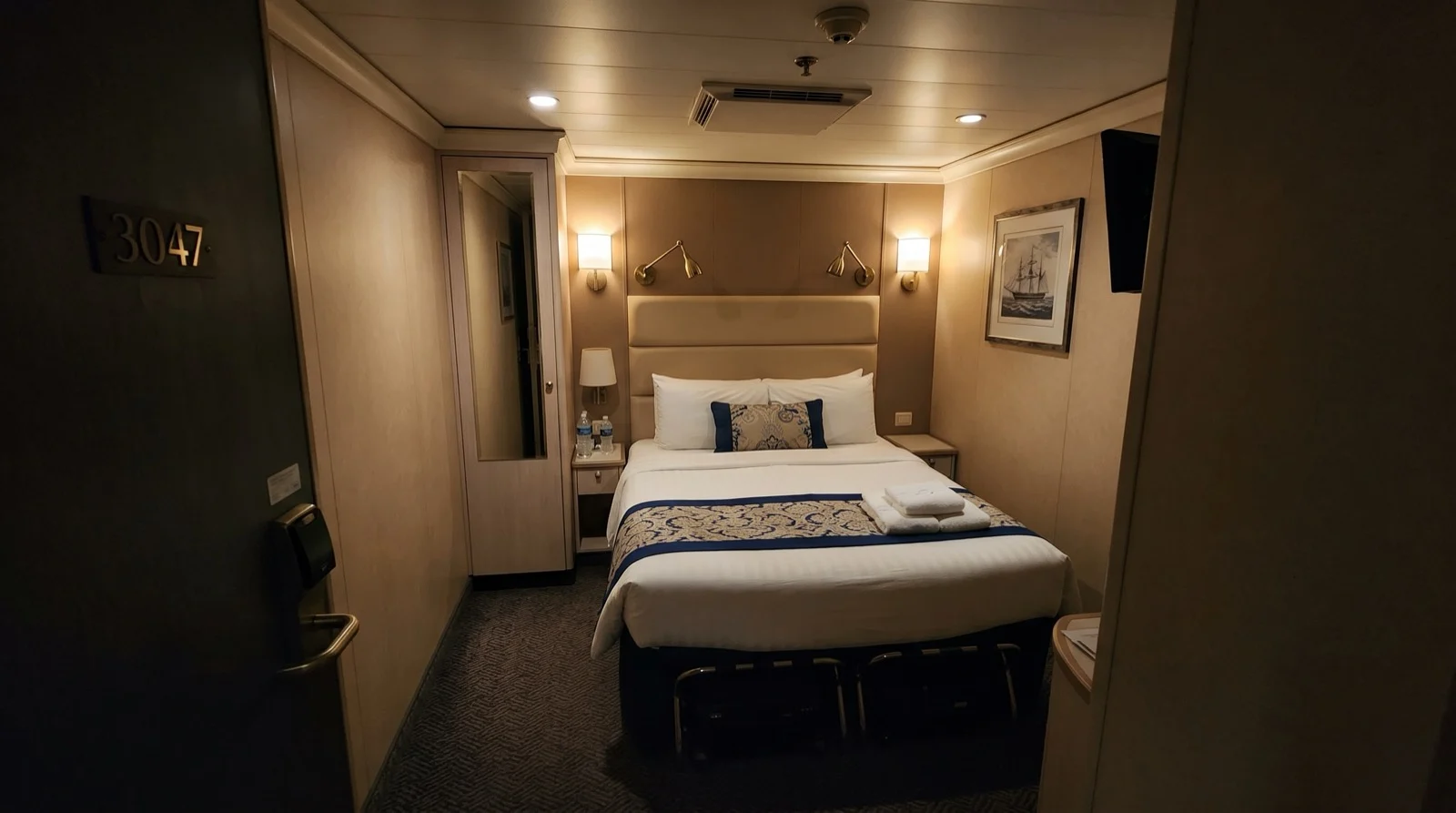
It’s worth it if the price difference matters more to you than natural light. It’s not worth it if you’re sensitive to sleeping in a windowless room for a full week.
An inside cabin has no porthole or balcony, so the room stays dark regardless of the hour outside. Some first-timers only notice this once they’re already oversleeping from the lack of a wake-up cue. If that sounds like you, an oceanview cabin solves it without the cost of a balcony.
Most of what goes wrong on a first cruise happens in two windows outside the ship’s control: the trip to the terminal, and the days you’re relying on your own phone signal instead of the ship’s.
Lock in the transfer and the data plan before you fly, and the rest of this list is mostly about knowing what to expect.
How much should you tip on a cruise, and how much are tips on cruises per day?
There’s no single industry number. The amount depends on the line and how it structures the charge, not on a flat rule you can apply everywhere.
Where a daily per-person service charge applies, it’s added automatically to the onboard account for the length of the sailing. Check the specific figure on your line’s own site before you sail rather than budgeting from a number a friend quoted.
Where do cruise tips go, and how are they divided among the crew?
The daily service charge and the automatic bar gratuity are pooled and distributed to the crew who worked your cruise: cabin stewards, dining staff, and the crew passengers rarely see, like laundry and galley teams.
The exact split isn’t usually published by any line, which is part of why the system feels opaque even though the money is moving to real staff.
Do cruise ship waiters and bartenders get tips separately?
Dining staff are typically covered by the daily service charge, the same pooled amount that pays cabin stewards. Bartenders are paid through a different pool: the automatic 18% to 20% gratuity on every drink is separate from the daily charge and goes toward bar and beverage staff specifically.
Do cruise workers get their tips, and what happens if you don’t tip on a cruise?
Yes. On lines that add the daily service charge automatically, it’s how the crew who worked your cabin and meals actually get paid, not a fee the line keeps. If a guest has it removed at guest services, that week’s pay for that specific crew drops.
On lines where tipping is fully optional, nothing is charged unless the guest arranges it themselves, usually in cash. Confirm which system your line uses before you’re standing at guest services with no signal. Having a working connection on your phone makes that a five-minute check instead of a guess.
Should you tip extra on a cruise, and is it better to pay gratuities upfront?
Extra cash on top of the daily charge is a personal add-on for someone who stood out, not a substitute for the automatic amount.
Whether to prepay gratuities at booking or let them accrue daily is mostly a budgeting choice: prepaying folds the cost into the upfront total, while the daily charge shows up as a running line item across the week.
Do cruise prices include tips?
Sometimes, depending on the line and sometimes the fare class within the same line. Some fares are marketed as “gratuities included,” others charge the daily service charge separately, and a promotional fare can change which bucket a booking falls into. Check the specific fare’s inclusions at booking, and again at online check-in.
Most of the surprises on this list trace back to one of two things: not checking your line’s policy ahead of time, or not having a way to check it once you’re already at the terminal or in port.
Sorting out data for the whole trip before you fly closes that second gap for good.