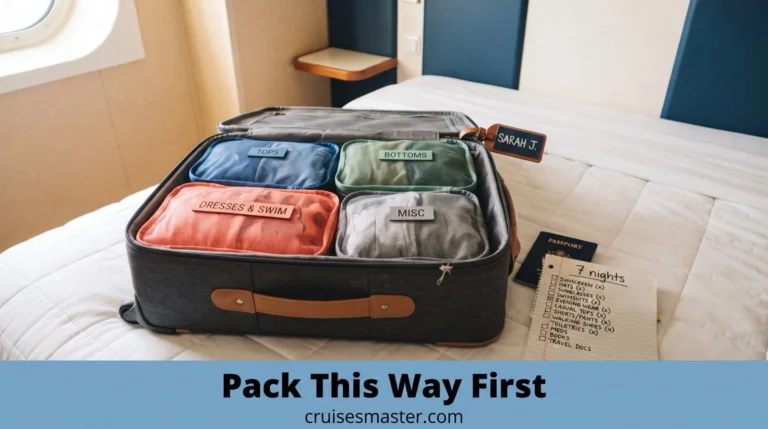
Across 8,980 posts pulled from cruise forums, the item first-time cruisers named out loud most often was a seasickness remedy, 19 mentions. A lanyard came second with 18, magnetic hooks third with 17. Nobody in that entire set asked the one question that would have saved them the most suitcase space: what does your cabin already have?
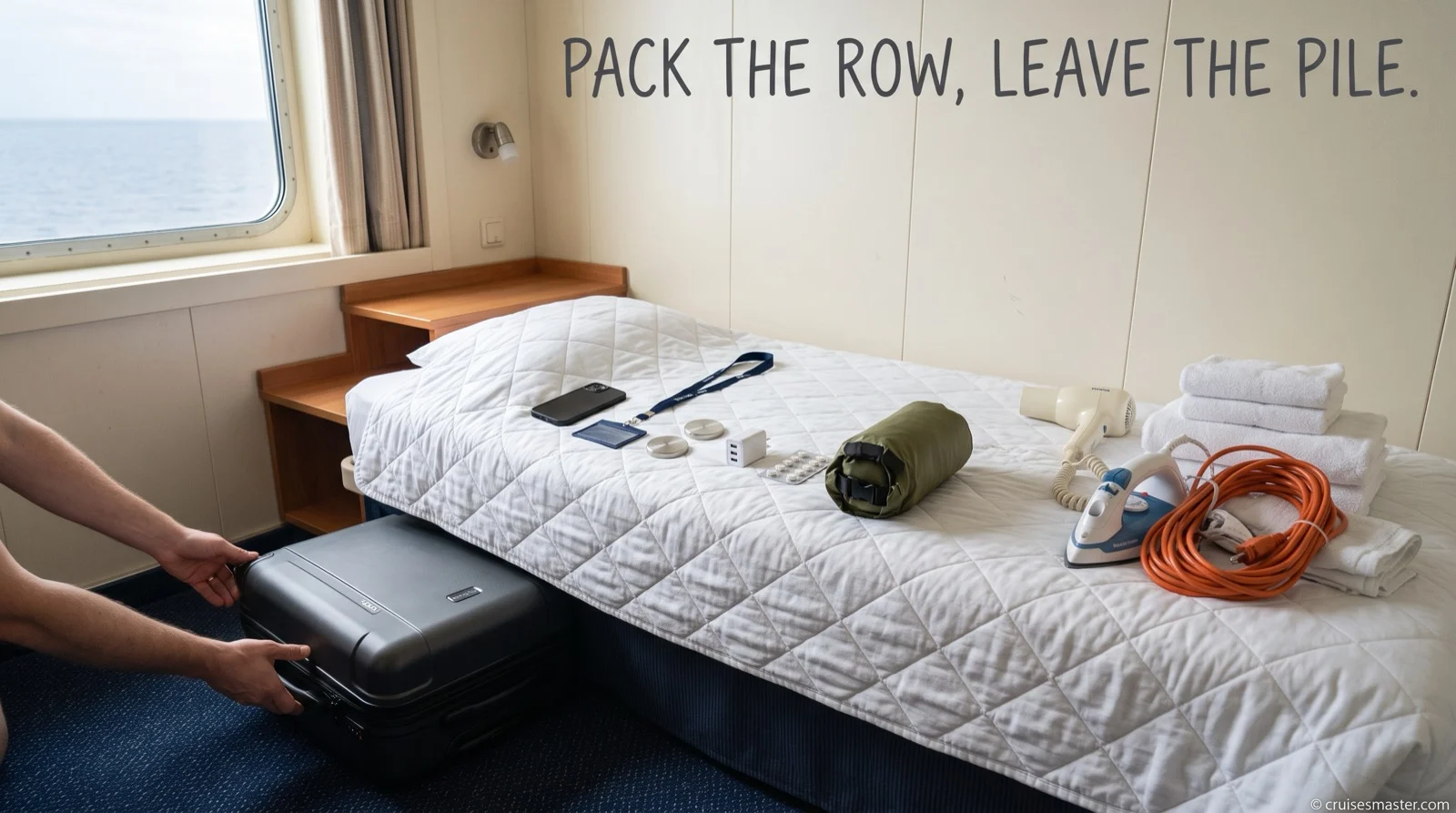
Every cruise essentials list you will find counts your suitcase in one direction only, add, add, add. I have sailed nineteen cruises across five lines (who I am), and I now pack the other way round. First you subtract everything the ship hands you for free. Then you pack what is left, and it fits in a smaller bag than you think.
Quick answer: before you pack a single item from someone else’s cruise essentials list, cross off these. They’re already in your cabin:
- Hair dryer: fitted in every cabin, no exceptions.
- Shampoo, conditioner, body wash: dispensers in the shower, every cabin grade.
- Towels: cabin towels and pool towels, both replaced daily.
- Ice: your steward fills the bucket if you ask once.
- An iron: not in the cabin (fire rules), but free in the self-service laundry on most lines.
And the short list of what the cabin never gives you at any grade: working internet at sea, a ride to the port, a booked shore excursion, and cover for the bag that misses the ship.
The Two-Minute Cruise Essentials List
If you’re packing tonight and reading this on your phone, here’s the whole article in one block. Everything below it is the why.
- Documents: passport or photo ID, boarding pass, card on file, printed luggage tags.
- Embarkation day bag: one full change of clothes, swimsuit, medication, charger, water bottle.
- Clothes: seven casual daytime outfits, two smart-casual dinner looks, one formal.
- Shoes: walking, water, dressy. Three pairs, no more.
- Power: one USB cube with several ports, no surge protector, no extension cord.
- Medical: seasickness remedy in two forms, your own prescriptions, small plasters.
- Cabin: magnetic hooks, a lanyard per person, a collapsible bag for laundry.
- Port days: a small dry bag, reef-safe sunscreen, a copy of the ship’s all aboard time.
Want every one of those lines expanded, with quantities? That is what my full cruise packing list does. Here I am doing the opposite job: telling you what to take back out.
One line above is worth bookmarking before you fly: load a data plan at home, because the terminal wifi queue is the worst place to discover you need one.
That’s it. Eight lines. The 85-item printable checklists that rank for this keyword aren’t wrong, exactly. They’re just counting a suitcase that’s already half-packed by the ship.
“A cruise packing list is a subtraction problem dressed up as an addition problem. The cabin has already packed half your bag.”
Start by Subtracting: What Your Cabin Already Holds
This is the section no other cruise packing list on the first page of Google has. I took a popular 85-item printable checklist and checked it line by line against what my cabin actually held on my last four sailings. Here’s what came out.
| On the standard checklist | Already in the cabin? | What that means for your bag |
|---|---|---|
| Hair dryer | Yes, every cabin | Leave it. It’s weak and slow, but it works. |
| Shampoo, conditioner, body wash | Yes, wall dispensers | Bring only what your hair actually needs. |
| Bath towels | Yes, replaced daily | Leave them. |
| Pool and beach towels | Yes, from the towel station | Leave them. |
| Bathrobe | Suites always, other grades on request | Ask, don’t pack. |
| Ice bucket and ice | Yes, ask your steward once | Leave the cooler. |
| Hangers | Yes, about eight | Pack a few flat ones if you hang everything. |
| Sewing kit, shoe shine, basic first aid | Guest services, free on request | Leave the kits. |
| Iron | No, fire rules. Free in the laundry room. | Leave it, plan a laundry visit. |
| Beach chairs, floats, coolers | Provided or not permitted | Leave them all. |
One line of the table has no “already in the cabin” answer on any ship: connectivity. That is the single item you still have to bring yourself, and an eSIM loaded before you fly is how it gets solved.
Cruise cabins really are stocked to a standard. One first-timers’ guide puts the baseline plainly: the line provides “basic toiletries, shampoo, conditioner, and body wash, in every stateroom,” and the hair dryer is listed as “already in your cabin.” Extra towels are “provided in cabins and pool areas.”
Grade changes the quality, not the presence. Suite guests “typically receive premium branded products while interior and oceanview cabin guests get standard dispensers.” So the question isn’t whether shampoo exists. It’s whether you can live with the dispenser for a week.
The one-line rule: if an item is heavy, liquid, or electric, check whether the cabin already has it before you pack it. Those three categories are where the suitcase weight actually lives.
Toiletries the Ship Hands You, and the Three It Never Does
“Do cruise ships provide toiletries?” is one of the most-asked questions on this topic, and the honest answer is: more than you think, but not everything.
What’s in the cabin already:
- Shampoo, conditioner and body wash in fixed shower dispensers.
- Hand soap at the sink.
- A hair dryer, usually in a drawer or mounted by the mirror.
- Toilet paper and tissues, restocked twice a day.
- Basic first-aid items and a sewing kit at guest services, free, on request.
Princess states it directly in its own packing guidance: the line “provides complimentary shampoo, conditioner and body wash.” That’s a cruise line telling you not to pack three bottles, and most people pack them anyway.
The three the ship never gives you:
- Anything for your specific hair or skin. Dispenser product is generic and drying. If your hair is colour-treated, curly, or simply fussy, bring a small decant, not the full bottle.
- Sunscreen. Shops on board sell it, at holiday prices, and often not in reef-safe formulas that some ports require.
- Your own prescriptions. The medical centre is not a pharmacy for routine refills, and it is the single item on this whole list you cannot replace mid-ocean.
Decant everything else. A cruise essentials list that tells you to bring full-size bottles was written by somebody who didn’t have to carry the bag up the gangway.
Reef-safe sunscreen matters most on the day you’re actually in the water, and a snorkelling stop is exactly where a reef-safe rule gets enforced by the tour operator, not just the port authority.
| Item | Ship provides it? | Pack it anyway? |
|---|---|---|
| Shampoo, conditioner, body wash | Yes, dispenser in shower | No — decant a small backup only if hair/skin is fussy |
| Hand soap, toilet paper | Yes, restocked daily | No |
| Hair dryer | Yes, drawer or wall-mounted | No |
| Sunscreen | Sold on board, rarely reef-safe | Yes — bring reef-safe from home |
| Prescription medication | No — medical centre isn’t a pharmacy | Yes, full trip supply plus a few spare days |
Towels: Cabin, Pool, and the One You Still Bring
Three kinds of towel exist on a ship, and only one of them belongs in the case you are packing.
- Cabin towels. Bath, hand and face, changed daily, plus more if you ask. Never pack these.
- Pool and beach towels. Taken from a station by the pool, sometimes signed out against your cabin number, returned before dinner. Never pack these either.
- A quick-dry travel towel. The only one worth suitcase space, for a port day when you are away from the ship and do not want to carry a soaked pool towel back through customs. Beach and snorkelling days are exactly when it earns its place.
Towel clips are the classic example of an item that lives on every checklist and dies in practice. I used to think they were a must-have. They are one more thing to pack, carry and remember, and on nineteen sailings I have wanted them exactly twice, both times on a windy sea day when the pool deck was half empty anyway.
The deck chair holds the towel fine on a calm sea day. On a windy one, you’re not on deck anyway.
The Hair Dryer, the Kettle and the Iron
 Pin it
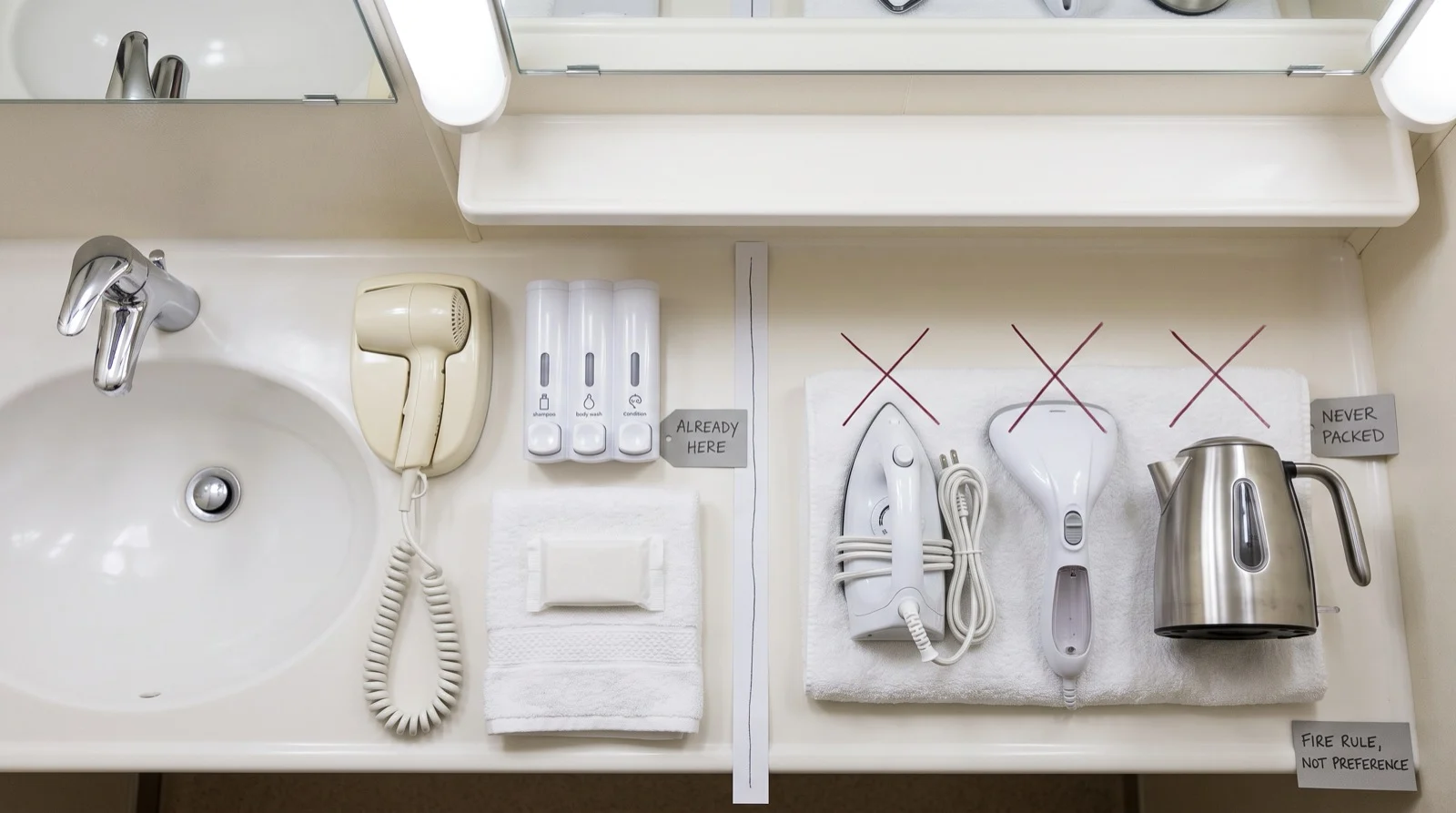
These three come up in every cruise packing question thread, and each has a different answer.
The hair dryer: already there, and it’s mediocre. Every cabin has one. It’s low-wattage by design. One packing guide describes the ship’s built-in dryer as “low-wattage and slow.” If your hair takes twenty minutes at home, budget forty on board.
That’s still not a reason to pack a second dryer in a bag you have to carry; it’s a reason to book a dinner table at 8pm instead of 6.
The kettle: depends on the line, and it’s rarely worth the fight. Some lines put a kettle in every cabin, some only in suites, some ban passenger-supplied ones outright as a heating element. Room service tea and coffee arrive free on most lines. Ask before you pack one.
The iron: not in the cabin, and it’s not negotiable. Fire-safety regulations usually prevent irons in cruise cabins. That’s the reason, stated plainly, and it explains why the rule never bends. Royal Caribbean’s prohibited list names both “clothing irons and garment steamers.” Another first-timers’ guide sums up the general position: “irons / steamers: fire hazardstrictly prohibited.”
Confusingly, some sources say steamers are fine while irons are banned. They’re describing different lines, not a loophole. Check your own line’s prohibited items page before you pack a steamer, because the officer at the scanner is going by their list, not by a blog.
- Princess gives you the workaround: the line “provides irons in self-service laundry rooms.”
- Most lines will press a few items for a fee, worth it for one formal outfit, not for a week of shirts.
- Hanging a creased dress in the bathroom during a hot shower still works, and costs nothing.
| Item | In the cabin? | Verdict |
|---|---|---|
| Hair dryer | Yes, every cabin | Leave yours, budget extra minutes |
| Kettle | Line and grade dependent | Ask before you pack one |
| Iron | No, fire-safety rule | Never pack, use the laundry room’s |
Each of those three answers changes by line and by ship, and the page that settles it lives on the line’s own site. I keep it open on my phone in the terminal queue, on my own data plan rather than the port wifi, because the officer at the scanner goes by that page and not by memory.
What Security Takes Off You at the Pier
 Pin it
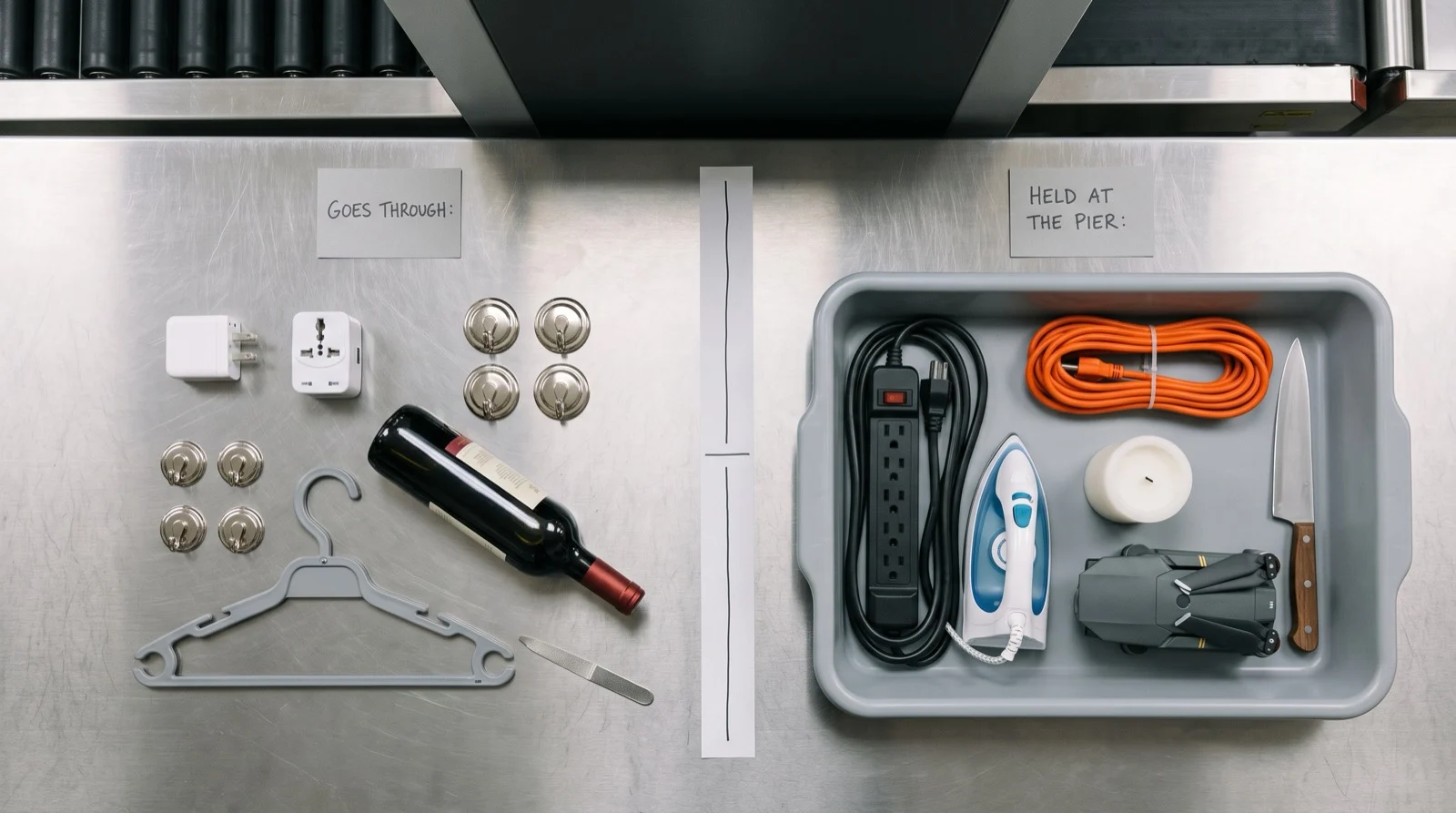
“What items are not allowed on a cruise ship?” deserves a straight list rather than a paragraph of hedging, because this is the stuff that gets pulled out of your bag in front of a queue.
Confiscated, almost universally:
- Surge protectors and extension cords. “Surge protectors and extension cords are banned from most cruise ships.” Royal Caribbean’s list names “extension cords, power strips, multi-plug outlets” outright. Princess allows them only when pre-approved: “extension cords with surge protectors (unless pre-approved).”
- Irons and, on many lines, garment steamers.
- Candles and incense. Carnival’s list reads “candles, incense, hookahs.” NCL names “candles and incense burners.”
- Knives and scissors. NCL draws the line at “knives with a blade longer than 4 inches/10.16 cm.” Royal Caribbean permits only “small grooming items, including nail files, cuticle tools, and scissors… with blades under four (4) inches,” and bans “hardware tools and screwdrivers exceeding seven (7) inches in length.”
- Drones. NCL prohibits “any remotely controlled or autonomously flying devices, toys or drones.” Princess says drones “are not permitted onboard for safety reasons.” Carnival takes a middle road: “drones must be declared during embarkation and held in the custody of the Chief Security Officer.”
| Item | Status at the pier |
|---|---|
| Surge protectors, extension cords | Confiscated, almost universally |
| Irons, most garment steamers | Confiscated |
| Candles, incense | Confiscated |
| Knives over 4 inches, large scissors | Confiscated |
| Drones | Held by security or banned outright, line-dependent |
| Paper door decorations | Banned on some lines, fine on others |
One detail catches people out every single sailing: NCL “does not allow paper door decorations, due to their flammable nature.” A magnetic sign is fine on most ships. A paper one, on that line, is not.
The confiscation that hurts most: a surge-protected power strip, bought specifically for the trip, taken at the scanner. The advice I’d give my past self is blunt, “don’t bring a surge protector and have it confiscated on embarkation day.” A USB cube with no surge protection does the same job and walks through.
Anything confiscated at the pier is gone for the sailing, and a few lines do not return it at all. That, and a bag that never arrives, is what a travel policy is for; the packing list cannot help you there.
Power: Outlets, Adapters and the Strip That Gets Confiscated
 Pin it
“Do I need a power adapter for a cruise ship?” and “can I bring a power strip on a cruise?” are the two electrical questions people ask, and they have opposite answers.
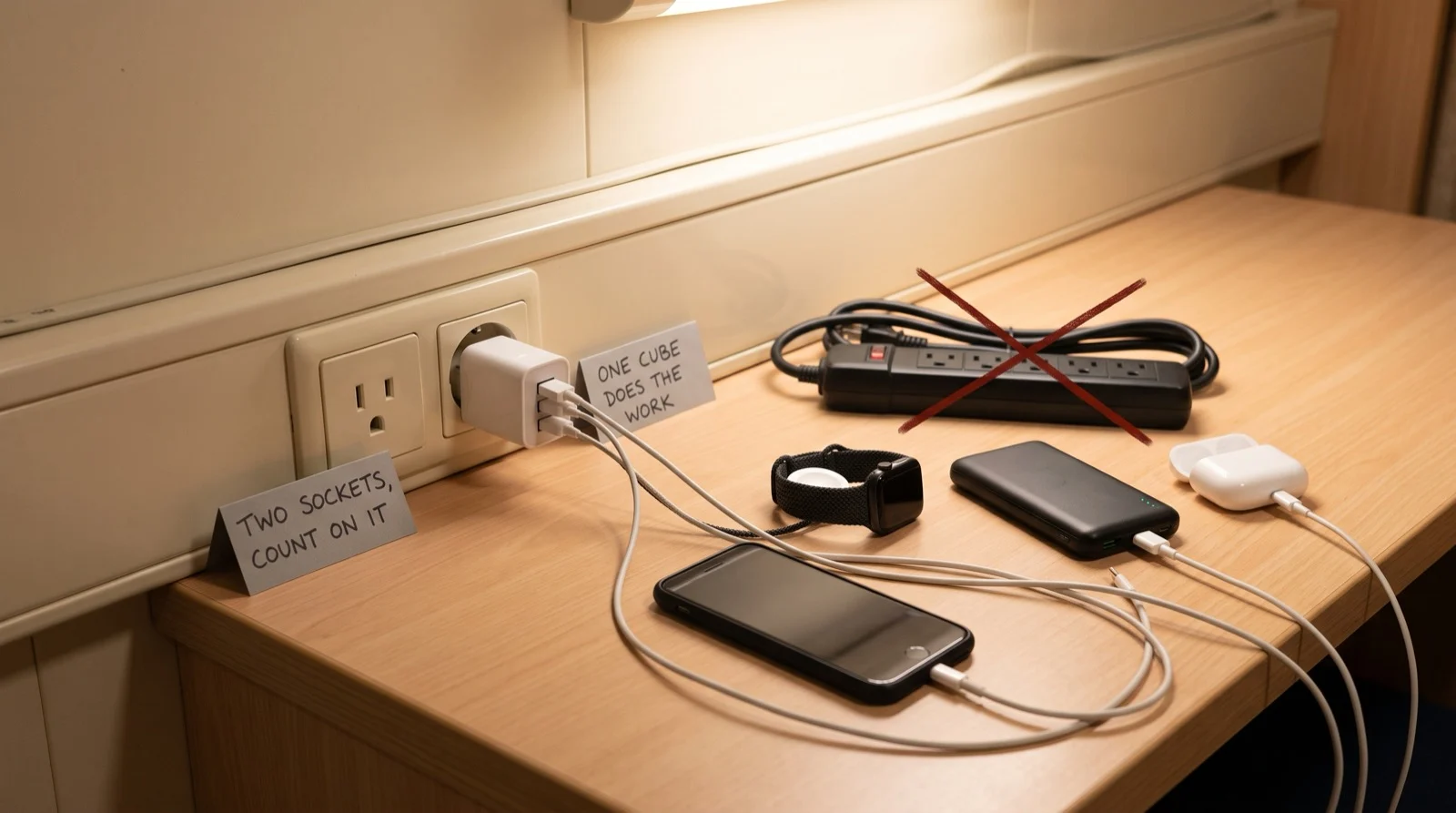
Outlets: count on two, hope for more. On older ships, sockets are scarce, and one guide describes “a sad lack of outlets” on older vessels. A first-timers’ guide puts that reality at “typically just one or two per cabin.”
Newer ships are the opposite: they are “designed so every cabin has enough electrical outlets and USB ports conveniently located throughout the room.” If you don’t know which you are sailing, assume the old one. Two people with two phones, a watch, a camera and a tablet don’t fit into two sockets.
What actually solves it:
- One multi-port USB charging cube, no surge protection, no extension lead, no separate plug per device.
- Short cables. Long ones tangle behind the desk and get left behind on the last morning.
- A power bank for port days. One 20,000mAh unit “lasts for two full phone charges plus earbuds,” which covers a long day ashore with maps and photos running.
Voltage: most modern ships carry both North American and European sockets in the cabin. Older ships often carry only one standard, and that standard usually follows the line’s home market rather than your route. Two minutes on your ship’s deck plan page tells you which; guessing costs you a dead phone on day one.
| Ship age | Typical outlets | What to bring |
|---|---|---|
| Older ship | 1–2 per cabin, one standard | USB cube, power bank |
| Newer ship | Several, both socket standards | Short cables only |
Embarkation Day Bag: Six Hours Without Your Suitcase
In our forum set, the suitcase was mentioned 171 times, arrival time 64 times, and the fear of being late 21 times, but only once did anyone mention the cabin not being ready. That’s the gap. Everybody worries about missing the ship; almost nobody plans for the six hours between boarding and the moment the suitcase appears outside the door.
What goes in the bag you carry on yourself:
- One complete change of clothes, including underwear.
- A swimsuit, the pools are open and empty on embarkation day, and everyone else is at the buffet.
- All medication, in its original packaging.
- Documents, cards, and the phone charger. If you are flying in, your pier transfer confirmation lives on the same phone.
- A refillable water bottle, empty through security, filled at the buffet.
- Anything you cannot replace: glasses, hearing aid batteries, a CPAP mask.
The muster drill came up 19 times in that same set, and it lands in this window too. On most lines you complete it on your phone plus a short visit to your station, before the ship sails. Carrying your day bag through it is fine. Carrying a full suitcase is not.
Documents and Money
Data at every port, no roaming shock
The eSIM I load before boarding, so photos post from the next port without a surprise roaming bill waiting at home.
 Pin it
Documents are the shortest section of any cruise essentials list and the only one where a missing item ends the trip at the terminal door.
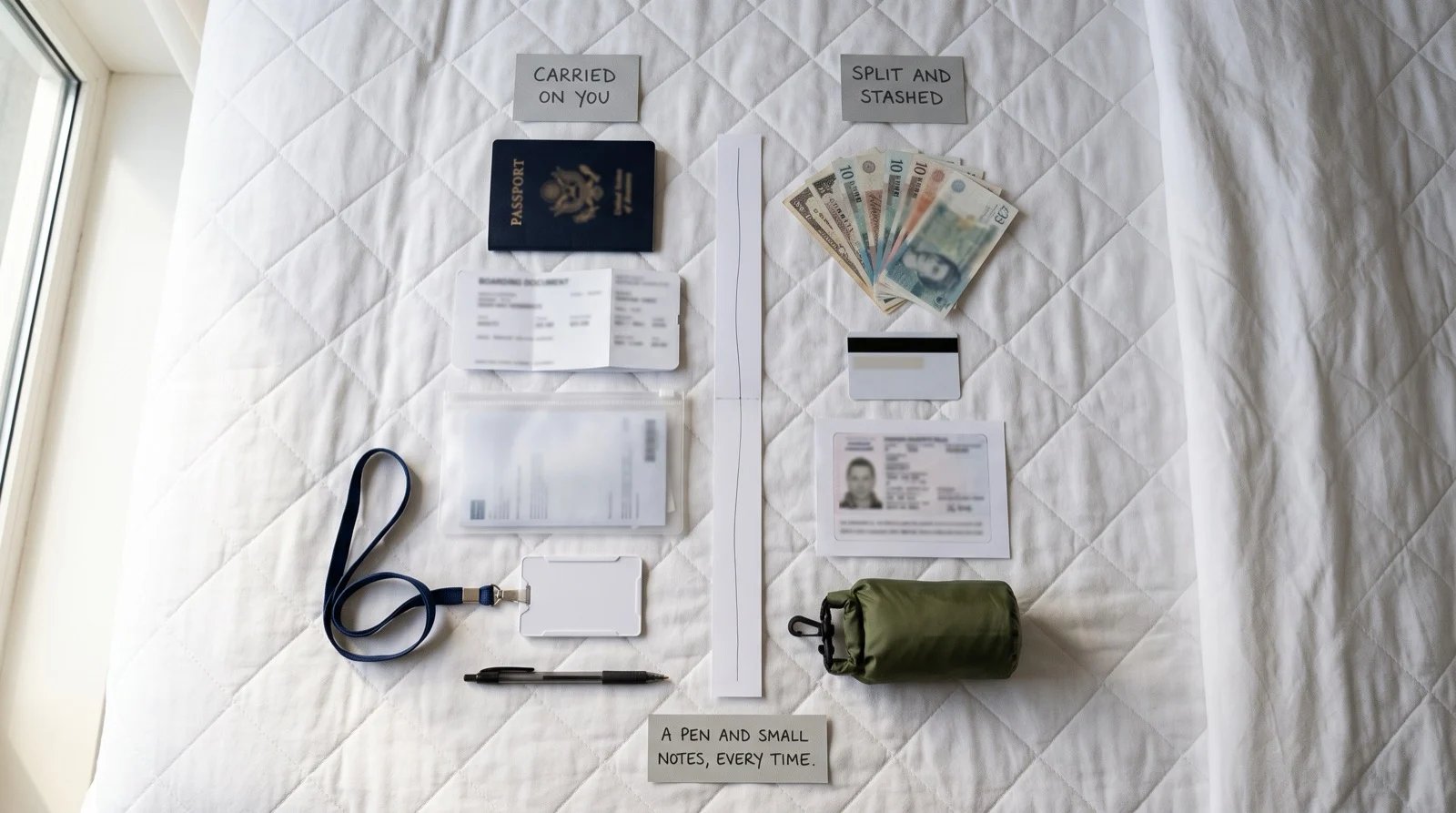
- Passport: always the safest choice, and mandatory on any route that starts and ends in different countries.
- Photo ID: on a closed-loop sailing you may not strictly need the passport: departing from and returning to the same U.S. port after at least one foreign call means “you are not required to bring your passport, but you will need a driver’s license or other form of photo identification.” I still bring the passport. A missed ship in a foreign port is a passport problem, not an ID problem.
- Boarding pass and luggage tags: print them at home. The terminal printer queue is not where you want to spend embarkation morning.
- One card on file, one card in the safe: plus a small amount of local currency for tips ashore and markets that don’t take cards.
| Document | Where it lives | Backup |
|---|---|---|
| Passport | On you at the terminal | Photo copy in your email |
| Boarding pass, tags | Printed at home | Line’s app |
| Cards | One on you, one in the safe | Small cash for tips |
If this is your first sailing, the rest of the day-one routine is in my cruise tips for first timers, from muster to tipping.
Photograph the passport page and keep the copy in your email. A lost document in a foreign port is a consular problem and a money problem at once, which is the half a travel policy handles.
Paper beyond that is dead weight. I stopped carrying piles of printouts years ago, and nothing has gone wrong since. Your line’s app holds the daily schedule, the deck plan and your onboard account, and guest services can reprint anything that matters.
Count Clothes by the Laundry Plan, Not by the Days
 Pin it
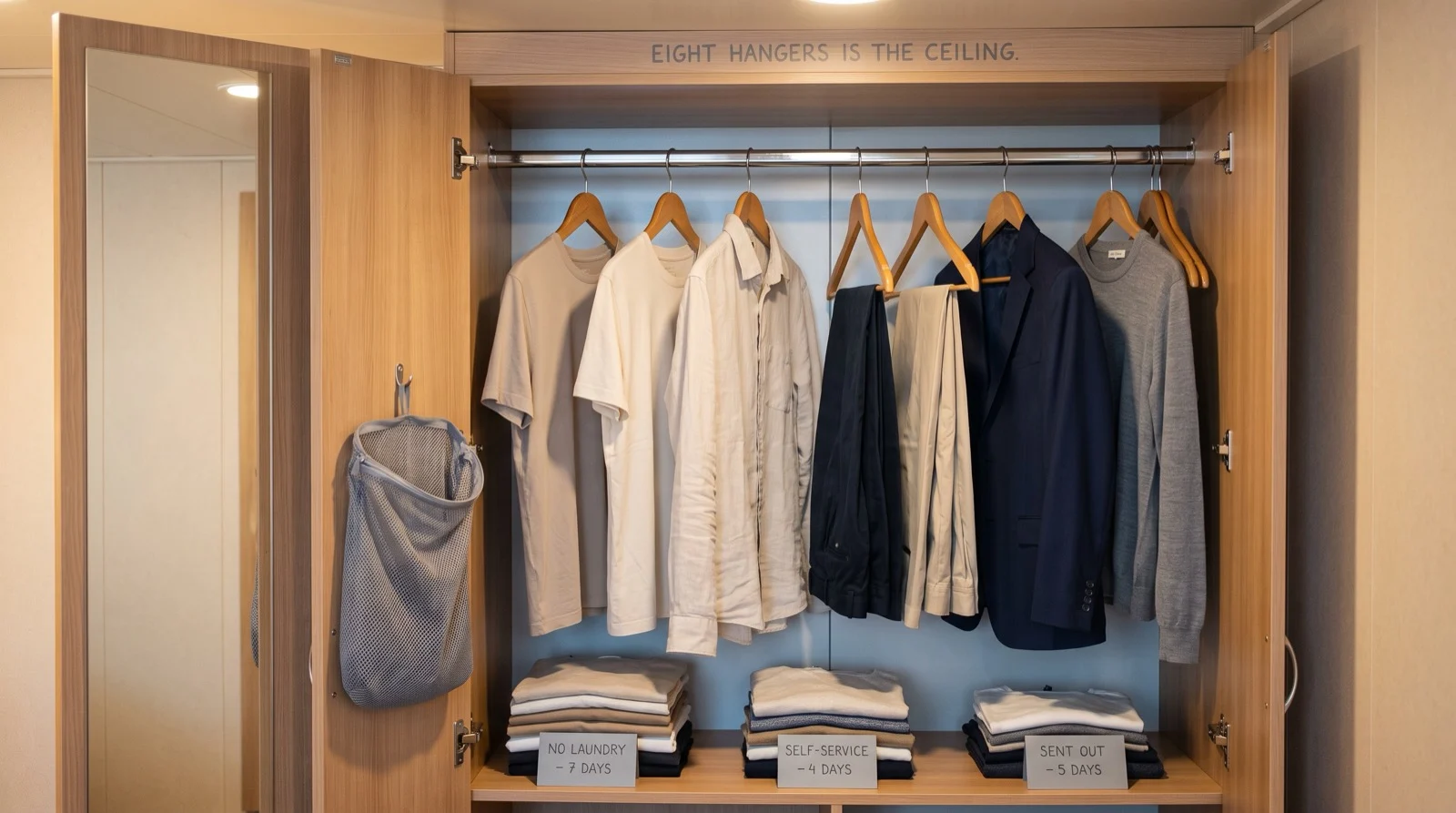
Every packing list tells you to bring one outfit per day. That number is set by the laundry plan, not by the calendar, and deciding the laundry first cuts the suitcase by a third.
Three plans, three different bags:
- No laundry. Pack for the full sailing. Seven nights means “7 casual daytime outfits, 2 smart-casual dinner looks, and 1 formal evening ensemble.”
- Self-service laundry. Pack four days of clothes and plan one machine visit mid-cruise. Go at 7am on a sea day; by mid-morning every machine is taken.
- Paid laundry service. Pack five days and send a bag out once. Most lines run a wash-and-fold service and many run a per-bag promotion mid-sailing.
| Laundry plan | Outfits to pack | Best for |
|---|---|---|
| None | Full sailing | Short trips, no time to spare |
| Self-service | Four days | Longer sailings, sea-day laundry run |
| Paid service | Five days | No interest in the machine room |
Whichever plan you pick, the whole week of clothes sits in one bag that an airline can misroute. That is the one packing failure you cannot solve by packing better, and the reason my policy includes baggage cover on every sailing.
The closet decides the rest. A ship’s closet holds “maybe 8 hangers for a 7-night trip,” so anything past eight hanging items lives folded in a drawer whether you planned for that or not.
- Pack tops that pair with every bottom, not outfits that only work as a set. My cruise capsule wardrobe is the long version of this one line.
- One warm layer, always. You will feel it: ships run the air conditioning cold, and evening decks are windy even in the Caribbean.
- A collapsible bag for dirty clothes, so your clean and your worn never share a drawer.
Formal Night Without a Second Suitcase
“Do I need formal clothes on a cruise?”, yes, for one or two evenings, and the requirement is far softer than the name suggests. “Most 7 night cruises have 1 to 2 formal nights,” and both can be covered by one outfit.
I stopped over-packing this part years ago, and the capsule approach is why. I still like looking nice for dinner; I just no longer feel the need to carry several formal outfits to do it.
- One formal look per person, worn twice if there are two formal nights. Nobody photographs the same room twice.
- Swap the accessory, not the outfit: a different scarf, a jacket on or off, different shoes.
- Skip the garment bag. It doesn’t fit under the bed and the closet won’t hold it.
- Can I wear jeans in the cruise ship dining room? On a casual night, on most lines, yes. On formal night, no. That’s the one evening the dress code is actually enforced.
If the suitcase carrying that one formal outfit is the one that gets delayed, that’s exactly the gap a travel policy naming baggage delay is meant to cover.
Shoes: Three Pairs and Why
Shoes are the heaviest thing in your bag per unit of usefulness. Three pairs cover your entire sailing.
- Walking shoes. Worn on the plane and on port days. Closed toe, already broken in, a blister on day two ruins four excursions.
- Water shoes or sturdy sandals. Beaches with rock or coral, wet tender docks, the pool deck. Water shoes came up 8 times in our forum set, always from someone who wished they’d had them.
- One dressy pair. Worn on formal night and at dinner. Flat or low, the deck moves.
That is it. Your fourth pair goes unworn on almost every sailing, and each pair is roughly the volume of two days of clothes.
Which of the three you lean on is decided by what you booked ashore, not by the packing list. A glacier walk in Alaska wants the broken-in walking pair; a snorkelling stop in Cozumel wants the water shoes. Book the day first, then pack the feet.
Pool and Swim Day
Pool towels are provided, so your swim section of your cruise essentials list is shorter than the checklists suggest.
- Two swimsuits. One of yours is always drying. This is the single item where doubling up is right.
- A cover-up that works as a dress over the swimsuit for lunch.
- Reef-safe sunscreen. Sunscreen was named 16 times in our forum set, second only to seasickness remedies among items people wished they’d packed. Several ports now require the reef-safe formula by law.
- A dry bag for the phone, small enough for a day pack. Mandatory if you have booked a snorkelling trip.
Leave at home: inflatable floats (not permitted on most lines), your own beach chair, a cooler. Beach days ashore rent all three.
Port Day Bag
Your port bag is where the cabin stops helping you. Everything you need ashore, you carry.
- Your ship card and a photo ID, both, every time.
- All aboard time written down, not remembered. It is usually 30 to 60 minutes before departure, and it is not negotiable.
- Your water bottle, filled on the ship before you leave.
- Sunscreen, hat, sunglasses.
- A small amount of local cash.
- Phone with an offline map of the port area saved before you disembark.
A lanyard was the second most-named item in our forum set with 18 mentions, and this is why: your ship card has to come out at the gangway twice in a day, and pockets lose things on a moving tender.
Seasickness and the Small Medical Kit
A seasickness remedy was the most-named item in the whole forum set, 19 mentions, ahead of every gadget. Pack it in two forms, because you cannot know in advance which one works for you.
- Tablets: taken before you feel anything, not after.
- Patches or bands: for people who don’t get on with the tablets.
- Ginger sweets: mild, and the only one you can take at your table without planning ahead.
What guest services will give you free, on request: basic plasters, a sewing kit, and on most lines a few tablets for motion sickness. That covers the small emergencies, so keep your own kit to what’s only yours:
- Prescriptions, in original packaging, in your carry-on.
- Painkillers you know work for you.
- Anything for a stomach upset, the one thing you will not want to queue at the medical centre for. What the centre does charge for is a question for your travel cover, not your wallet.
- Blister plasters, because of point one in the shoes section.
Cabin Hacks Worth the Suitcase Space
A short list, because most “cabin hacks” solve problems your cabin already solved for you.
- Magnetic hooks. Third most-named item in our set, 17 mentions, and the one hack that earns its space: “most walls on cruise ships are made of metal,” so hooks hold. Hats, lanyards, wet swimsuits, the day’s schedule.
- A small power cube: covered above, and the item that fixes the two-socket cabin. Pair it with a loaded eSIM so the phone is useful as well as charged.
- A night light for an inside cabin. With the lights off there is no daylight at all, and finding the bathroom at 3am in a dark, unfamiliar room is how people trip.
- A collapsible laundry bag. Three dollars of fabric that keeps the cabin liveable all week.
What I left off, deliberately: over-the-door organisers and door decorations. Both came up in our forum set only 3 times each, and I have dropped both. The large organisers are not necessary once the drawers are used properly, and decorations take up space I would rather give to clothes. On NCL the paper ones are not allowed at all.
A small fan also showed up 3 times. Cabins run cold on every ship I’ve sailed; this one is a personal preference, not an essential.
Staying Online at Sea: the One Thing the Cabin Never Gives
Everything above this point was a subtraction. This section is the opposite: no cabin, at any grade, on any line, gives you working connectivity. The ship sells satellite Wi-Fi by the day, and the moment you walk down the gangway in a foreign port, that stops working.
What actually happens on a port day:
- Ship Wi-Fi ends at the gangway. Roaming charges start at the pier.
- Free port Wi-Fi exists in terminal buildings and nowhere else useful.
- Your map, your ride back and your all aboard countdown all live on the phone.
An eSIM loads before you leave home.
It activates when you land in each country, which is the difference between a working map in a strange port and a guess. I run one as the main line and keep a second provider loaded as a backup, because coverage on Caribbean and Alaskan itineraries varies by island more than any coverage map suggests.
Real cabin comparisons. Fares that actually move.
Booking links straight to the line.
Compare faresData for your whole itinerary
One plan that follows the ship between countries, loaded before you leave home.
A backup eSIM per country
Useful when one island on the route has thin coverage and the rest are fine.
Getting to the Port Without the Morning Panic
Data at every port, no roaming shock
The eSIM I load before boarding, so photos post from the next port without a surprise roaming bill waiting at home.
Arrival time was named 64 times in our forum set and the fear of being late 21 times, together, the single biggest source of stress in the whole data set, bigger than packing itself.
What removes it:
- Fly in the night before. Always, on any itinerary that involves a plane.
- Book the transfer in advance, with a fixed pickup time, rather than joining the taxi queue with 3,000 other passengers.
- Leave the hotel for the pier before your assigned window rather than after it, the terminal is more comfortable than the lobby, and the ship is more comfortable than both.
- Keep the day bag with you from door to cabin, not in the boot of a car you’ve said goodbye to.
Shore Excursions Worth Booking Before You Sail
The packing list ends at the gangway; the trip doesn’t. The excursions that sell out are the small-group ones, and they go weeks before you sail, not on the morning you walk ashore. Three that I’d book ahead on the routes most first-timers take:
Real cabin comparisons. Fares that actually move.
Booking links straight to the line.
Compare faresJuneau: whale watching
Alaska’s most-booked port day, and the boats are small. Pack the warm layer and the waterproof, the deck is where you’ll stand the whole time.
Juneau: Mendenhall Glacier
The same port, the other direction. Walking shoes, not sandals, and the trails stay wet even on a dry day.
Cozumel: reef snorkelling
The reason water shoes and reef-safe sunscreen are on this list at all. Bring your own mask if you’re particular about the fit.
Whatever you book, put the return time in your phone against the ship’s all aboard time, not the tour’s stated finish. Independent tours are not held for, and that’s the one mistake on this page you cannot pack your way out of.
Cover for What the Packing List Can’t Fix
A packing list solves only the problems inside your suitcase. It does nothing about the suitcase that doesn’t arrive, the itinerary that changes mid-sailing, or the medical centre visit in international waters.
- Delayed or lost bag. Your carry-on outfit covers one day, not a week.
- Missed departure. Catching the ship at the next port is an expensive day.
- Medical care at sea. Shipboard care is billed separately from anything your usual cover assumes.
- A changed itinerary. Ports get swapped for weather and mechanical reasons, and the pre-booked tour ashore doesn’t refund itself.
What I Stopped Packing After Nineteen Cruises
This is the honest version of the list. Every one of these came on an early sailing and came home unused, so you can skip the lesson.
- A second hair dryer. The cabin one is slow, not absent.
- Full-size toiletries. Dispensers plus decants cover everything except the fussy items.
- Towel clips. One more thing to pack, carry and remember.
- Door decorations. Banned in paper form on some lines, and space I’d rather have.
- An over-the-door organiser. Two magnetic hooks do 80% of the same job at 5% of the volume.
- Printed paperwork. The app holds all of it, on whatever data plan gets you online before you’re anywhere near ship wifi.
- Several formal outfits. One, worn twice.
- A beach towel. Provided, at the pool and at the gangway.
- A fourth pair of shoes. Unworn on every single sailing.
- A surge-protected power strip. Confiscated once, never replaced.
Ten items. Between them they are most of your carry-on, and losing them is why I now travel a week on a bag that fits under the bed.
The First Evening, and the Two Things People Forget
Embarkation day has a rhythm nobody tells you about the first time, and two items solve almost all of it.
- The muster drill. It happens on day one, it’s legally required, and on most lines you now do it through the app and then check in at your station. You need your phone and your cabin card in hand, not in the safe, not in the case still standing in the corridor.
- Dinner on night one. The main dining room is open, the buffet is chaos, and your case may still be outside the door. The change of clothes in your day bag is what gets you to a table looking like a passenger rather than an arrival.
The two forgotten items, every time: a pen and a small amount of cash. The pen is for the customs form, the tour sign-up sheet and the tag on your luggage. The cash is for the porter who takes your case at the pier, which happens in the first sixty seconds of the trip, before you’ve reached anything you packed.
The porter meets you at the pier, which is the end of a journey that starts at the airport. A transfer booked in advance is what turns that morning from a queue into a drive.
Everything else on day one waits. Empty the case after dinner, not before it, the cabin is quieter, the case has arrived, and you’ll do it properly instead of at speed.
The Suitcase Itself, and How It Gets Out of the Way
Your cabin is small in a specific way: the floor space is the room. Whatever you can’t put away stays underfoot for a week, so the bag matters as much as what’s in it.
Size it for the bed, not for the airline. A case up to around 14 inches high and 24 inches wide slides under most cabin beds. Bigger than that and it lives in the corner, in your way, every single day.
- Two medium cases beat one large one for a couple, each fits under the bed, and neither is the one you can’t lift over the threshold.
- Soft-sided wins on a ship. It squashes flat under the bed in a way a hard shell doesn’t.
- Packing cubes earn their space here more than they do on land. The closet holds around eight hangers; everything else lives in shallow drawers, and cubes are what stop a drawer becoming a pile by day three.
- Pack a few flat hangers if you hang everything. Eight goes quickly between two people.
Empty the case completely on the first evening. It takes you twenty minutes, and it is the difference between a cabin and a storage unit, and the wardrobe is deep enough. It’s the hanger count that isn’t.
If the case doesn’t turn up empty because the airline sent it somewhere else for a day, that’s the exact scenario a travel policy naming baggage delay is built for.
The test: once the case is empty, you should be able to stand in the middle of the cabin with nothing on the floor. If you can’t, the case was too big, not the cabin.
| Case choice | Fits under cabin bed? | Best for |
|---|---|---|
| One large hard-shell | No — lives in the corner | Never, on a ship |
| One medium soft-sided | Yes, up to ~14×24 in | Solo traveller |
| Two medium soft-sided | Yes, both | Couples — each lifts one, not one heavy shared case |
What Changes by Route: Alaska, Caribbean, Europe
 Pin it
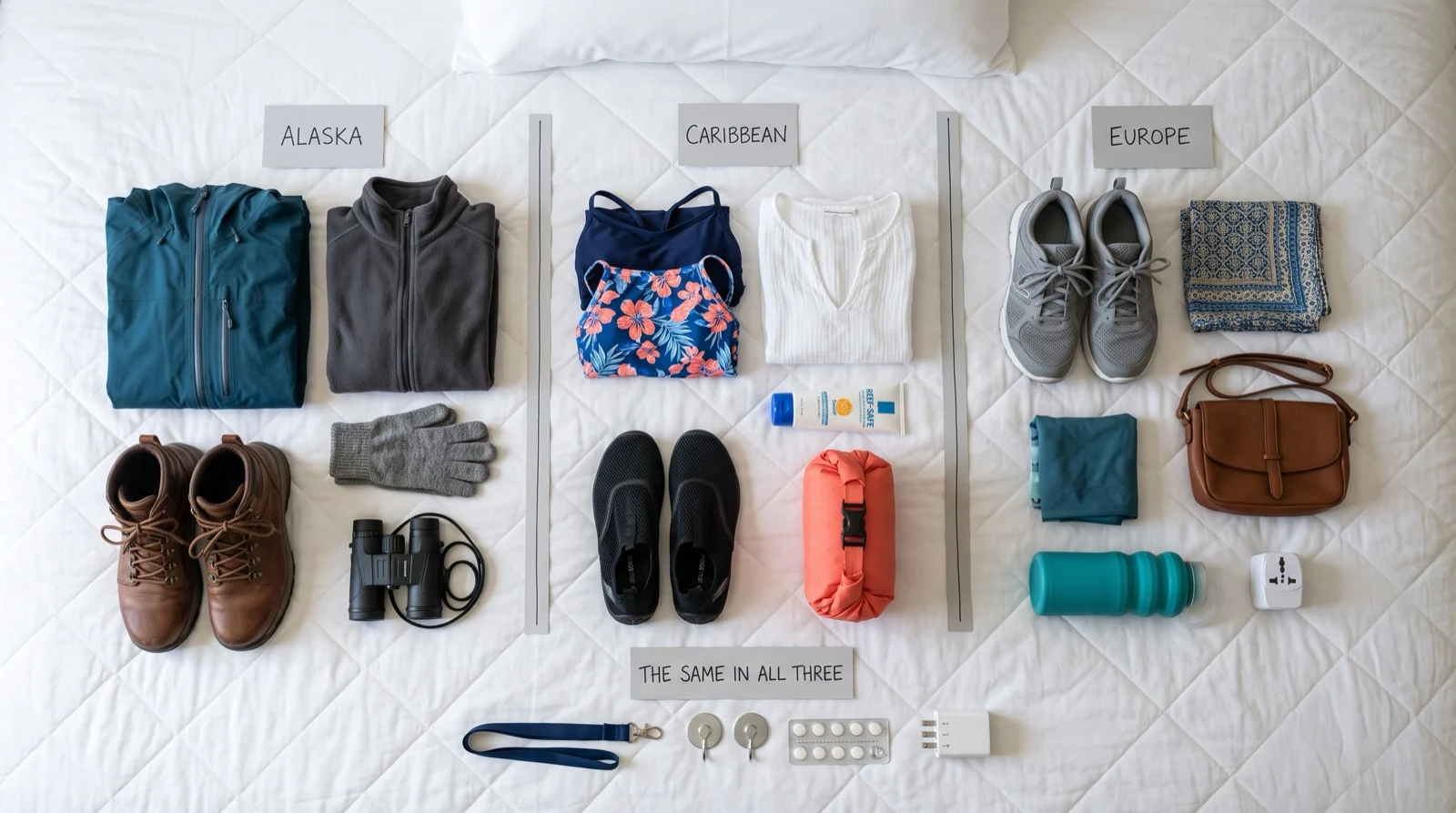
Everything above is true on any ship. These are the deltas: if you have sailed before, this is the only part you need.
Alaska. The ship is warm; the deck is not, and the deck is where the glaciers and the whales are.
- A waterproof outer layer, not a warm one. Rain is the constant, cold is intermittent.
- Layers you can take off indoors, thermal base, fleece, shell.
- Binoculars, one pair per cabin. This is the one itinerary where they get used daily, and the whale boats out of Juneau are where you will want them.
- Walking shoes with grip. Glacier trails stay wet even on a dry day.
- Leave the swimsuit? No, the pool is heated and half covered, and the hot tub in the rain is the point.
Caribbean. Heat, salt water, and short walks between your pier and your beach.
- Reef-safe sunscreen, required by law in several ports.
- Water shoes for rock and coral beaches, and for the reef trips in Cozumel if you have booked one.
- A dry bag for the phone on tender days.
- A light long-sleeve layer for the sun, not the cold, it beats reapplying sunscreen to your shoulders all afternoon.
- Leave the heavy jacket. One warm layer for the air conditioning is enough.
Europe and the Mediterranean. Port days are cities, and cities mean walking, steps and dress codes at religious sites.
- Shoulders and knees covered for churches, one scarf solves it for a whole itinerary.
- Walking distances double: comfortable shoes are not optional, they’re the trip.
- A day bag that closes properly, worn in front in crowds.
- A plug adapter you can rely on, since older ships on these routes rarely carry both socket standards.
- Book port transfers and timed-entry tickets ahead: the ports sit an hour from the cities they are named after more often than you would think.
| Route | Extra items | Skip |
|---|---|---|
| Alaska | Waterproof layer, binoculars, grippy shoes | A single heavy coat |
| Caribbean | Reef-safe sunscreen, water shoes, dry bag | The heavy jacket |
| Europe/Med | Shoulder-covering layer, reliable adapter | A second pair of dress shoes |
Across all three, the cabin’s contribution doesn’t change. The hair dryer, the towels and the dispensers are the same in Juneau as in Cozumel; only the layer you put over the top of them moves.
The Subtraction Checklist
Print this or screenshot it. It is built the opposite way round from the usual cruise essentials packing list: the first column is what you leave at home.
| Leave it, the ship has it | Pack it: the ship doesn’t |
|---|---|
| Hair dryer | Seasickness remedy, two forms |
| Shampoo, conditioner, body wash | Your own prescriptions, in the carry-on |
| Bath and pool towels | Reef-safe sunscreen |
| Bathrobe (ask instead) | Lanyard per person |
| Ice and cooler | Magnetic hooks |
| Iron (use the laundry room) | Multi-port USB cube, no surge protector |
| Sewing kit, plasters, shoe shine | Power bank for port days |
| Beach chairs and floats | Two swimsuits, one cover-up |
| Extension cords and power strips | Refillable water bottle |
| Candles, incense, drones, large knives | Quick-dry travel towel |
| Piles of printed paperwork | Warm layer for evening decks |
| A fourth pair of shoes | Collapsible laundry bag |
One line on this table has no substitute on board: the connection. Load your data plan before you leave home, because the first place you will need it is the pier, before you have unpacked anything.
Key Takeaways
- The cabin already packs half your bag: hair dryer, toiletries, towels, hangers, ice and first-aid basics are all on board.
- Fire rules explain most of the prohibited list, irons, candles, surge protectors and extension cords all fail for the same reason.
- Count clothes by the laundry plan, not by the number of days.
- Three pairs of shoes, two swimsuits, one formal outfit. Everything past that comes home unworn.
- The cabin never gives you connectivity, a ride to the pier, a booked excursion, or cover for a bag that misses the ship. Those four are what the packing list can’t solve.
Cruise Essentials FAQ: the Questions People Actually Search
Do cruise ships provide toiletries?
Yes. Every cabin grade has shampoo, conditioner and body wash in shower dispensers, plus hand soap. Suites get branded products; interior and oceanview cabins get standard dispensers. Bring your own only for hair or skin that needs something specific.
What toiletries does a cruise ship provide, exactly?
Shampoo, conditioner, body wash, hand soap, tissues and toilet paper as standard. A sewing kit, basic plasters and shoe shine are free on request at guest services on most lines. Sunscreen and prescriptions are never included.
What should I NOT pack for a cruise?
Extension cords, surge-protected power strips, irons, candles, incense, drones on most lines, knives with blades over four inches, tools over seven inches, and inflatable floats. Also skip a second hair dryer, beach towels, and a fourth pair of shoes.
Do I need travel insurance for a cruise?
The packing list can’t cover a missed sailing or a clinic visit in a port. Medical care on board is charged like private practice, and the ship leaves on time whether your flight lands or not. I sail with a travel policy that covers cruise itineraries and keep the certificate in the same folder as the boarding pass.
How do I get from the airport to the port?
Book the transfer before you fly, not in the taxi queue at 7am with a suitcase. A pre-booked port transfer waits for the flight and takes a fixed route to the terminal, which matters on embarkation day when the all-aboard time is the only deadline that counts.
Can I bring a power strip on a cruise?
Not a surge-protected one. Surge protectors and extension cords are banned on most ships, and Royal Caribbean names “extension cords, power strips, multi-plug outlets” outright. A USB charging cube without surge protection passes the scanner and solves the same problem.
Are magnetic hooks allowed on cruise ships?
Yes, and they work, most cabin walls are metal. They’re the single most useful item you can add to your bag for the space they take.
What size suitcase fits under a cruise ship cabin bed?
A bag up to around 14 inches high and 24 inches wide fits under most cabin beds. Getting the suitcase out of the way once the case is empty matters more on a ship than anywhere else, because the floor space is the room.
Do I need a power adapter for a cruise ship?
Often, yes. Newer ships carry both North American and European sockets in the cabin; older ships usually carry only one standard, and it follows the line’s home market rather than your route. Check your ship’s cabin page before you sail.
How many outfits should I pack for a 7-night cruise?
Seven casual daytime outfits, two smart-casual dinner looks and one formal outfit, if you’re not using the laundry. With a mid-cruise laundry visit, four days of clothes is enough.
Do I need formal clothes on a cruise?
For one or two evenings. Most seven-night sailings have one to two formal nights, and one outfit covers both. Jeans are fine in the dining room on casual nights and not on formal ones.
Can I bring my own alcohol on a cruise?
In limited quantities at embarkation. Carnival permits one 750ml bottle of wine or champagne per person and excludes fortified wines over 15% ABV. Princess allows each guest 21 and over one 750ml bottle. Check your own line, because the allowance and the corkage differ.
Can I bring soda or bottled water on a cruise ship?
On some lines. Carnival permits up to 12 sealed cans of soda per guest, and Royal Caribbean allows 12 bottles of water up to 17 oz each. Sealed and carried on by hand, not in checked luggage.
Do I need packing cubes for a cruise?
They help more on a ship than on land, because the closet holds around eight hangers and everything else lives folded in shallow drawers. Cubes keep a drawer from becoming a pile by day three.
Should I bring a reusable water bottle on a cruise?
Yes. Empty through security, filled at the buffet, and it’s the item you’ll want most on a port day when the nearest shop is a twenty-minute walk.
Do I need internet on a cruise ship?
You need it ashore more than on board. Ship Wi-Fi stops at the gangway, so a data plan loaded before you fly is what keeps the map, the ride and the all aboard countdown working in port. A second eSIM covers the island where the first one is thin.
What cruise packing items are overrated?
Towel clips, over-the-door organisers, door decorations, a second hair dryer, and anything described as a cabin hack that solves a problem the cabin already solved.
One last thing that is not in the suitcase at all: get yourself to the pier without the morning queue, with a booked transfer, and cover the bag that might not arrive with a policy that names baggage delay. Those two are the only parts of this list the cabin will never hand you.